Enhancing Kubernetes Operations: Understanding AI Agent Success Metrics
Sep 15, 2026 · 501 views
AI agents are transforming Kubernetes by automating operations, but key checks must ensure successful state management and outcome verification.
Rethinking Agentic Kubernetes Remediation
What we're witnessing in the Kubernetes ecosystem is a tectonic shift: autonomous AI agents are stepping up to manage operations with unprecedented ease. The big talk these days is about newly minted capabilities—Red Hat's OpenShift project is on the verge of rolling out a Go-based Model Context Protocol (MCP) server that interfaces directly with Kubernetes. This will allow AI systems to command and adjust cluster resources with built-in safety nets to avert cataclysmic errors. Startups are also jumping on this bandwagon, introducing platforms that promise to autonomously identify and rectify production incidents, thus reducing human intervention. But here's the crux: while the focus often revolves around what these agents can achieve—like performing rollbacks or scaling deployments—we're missing a fundamental issue.
Let’s be real for a moment: granting an agent write access to a live cluster isn’t the main hurdle anymore. The MCP equips servers with a consistent method to expose various cluster operations like scaling or deleting. Plus, Kubernetes' Role-Based Access Control (RBAC) has us covered on limiting what actions these agents can undertake. But here's the kicker: just because a tool gives a success signal doesn’t mean the operation was successful in achieving the desired outcome. The pressing concern isn’t whether the agent can execute a command but, rather, how we can verify that the state of the cluster post-command aligns with expectations.
Which raises the question: How do we ensure that an agent's inference from a tool-call is reliable? It’s not enough to simply celebrate a successful tool response. It fails to prove that the cluster has transitioned to the intended state, or that an application crucial for service continuity truly recovered. These aspects—call legitimacy, state change accuracy, verification of the intended state, and actual service outcome—are intertwined yet distinct, and reducing them to a single success or failure metric is misleading at best.
Disaggregating Success
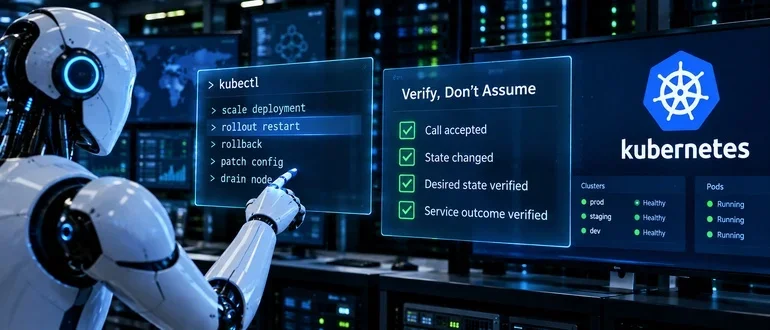
When discussing cluster management, we must break down success into four essential checks, each one needing rigorous validation.
1. **Was the call accepted?** Just because a request was sent doesn't guarantee it reached the control plane. Network disruptions can lead to uncertainties. Unlike traditional retry mechanisms, AI agents lack the instinctual skepticism and understanding of discrepancies that engineers might bring.
2. **Did the state change without unintended duplications?** Success from the server’s perspective doesn’t ensure that an operation took effect as intended. Agents need to navigate the potential pitfalls of non-idempotent operations—if an agent re-sends a command without confirming its initial success, it could inadvertently cause further issues.
3. **Does the desired state align with reality?** Tools may report success when, in reality, the state remains unchanged. An agent should re-observe the cluster's condition rather than blindly trust the response it received.
4. **Was the application genuinely restored?** This is a commonly overlooked aspect but remains crucial. Even if a deployment reflects as healthy, the underlying application could still harbor unresolved faults. The system might show a green light while critical issues loom undetected.
These foundational checks are where the real complexity lies. An agent that takes any of those assertions at face value without validating them risks basing subsequent actions on an erroneous reality.
Intent vs. Execution
Even when an agent seemingly executes steps without a hitch, hidden failings can still undermine the entire operation. Imagine an agent instructed to resolve a crash loop; in successfully enforcing a deployment scale to zero, the agent might create unintended service downtime. Here, the execution of its function was technically flawless, yet its objective wasn't met, resulting in increased service degradation.
This scenario sets a higher standard for outcome verification—what needs to be confirmed isn’t just if the action taken was effective, but whether it aligns with the operator's intentions. This introduces a complex layer of verification that necessitates comparing the agent's outcomes against independent indicators of operational health, rather than solely the return values from its commands.
Building Verification into Design
The silver lining is that many of the challenges inherent in this new approach are not novel—they mirror long-standing issues faced in the architecture of distributed systems. Thus, the solutions exist in the form of structured engineering contracts and design principles.
Key mechanisms will be pivotal:
- **Idempotency** ensures that operations are repeatable without negative effects when errors occur during acknowledgment.
- **Postcondition verification** adds another layer, confirming that intended outcomes are truly realized rather than assumed.
These mechanisms shift the landscape of what tools should convey; instead of a binary success or failure, we need a structured lifecycle status that reflects the entire process. For example, a tool might report: accepted, applied, converged, service-verified, or outcome-unknown, directly corresponding to the important checks we've discussed.
As we think about the future of agentic operations in Kubernetes, it’s essential not to shortcut these discussions. Autonomous systems are cropping up in this space regardless of our readiness, and while the capabilities are promising, there’s a pressing need to ensure that these agents don’t mistakenly equate tool-call success with operational success. We’ve seen firsthand how false impressions can lead to systemic failures. Pay attention to the details that many are glossing over—those are the real game-changers.
Rethinking AI in Kubernetes Management
As organizations increasingly turn to AI for managing Kubernetes environments, the need for rigorous verification processes becomes essential. Successfully executing a command doesn’t equate to effective remediation of application issues. In the world of Kubernetes, just because an operation is acknowledged as successful doesn’t mean it achieved the desired outcome, like restoring a cluster to a healthy state. This misunderstanding can lead to severe operational pitfalls.
What we're seeing is a tendency to accept responses from AI agents at face value, without considering the nuanced realities of cluster state management. This gap highlights an urgent need for robust postcondition verification processes. After any intervention, it’s critical to reassess the cluster to ensure that it reflects the desired state, rather than blindly trusting the initial success message.
If you’re involved in managing Kubernetes clusters, think about what you would need to unleash AI agents effectively. It's not just about the AI's capability to execute commands; what’s necessary are durable operation identifiers and independent health checks. Additionally, any automation should have mechanisms to handle uncertainty and provide enough observability to tie actions back to outcomes.
This isn’t simply a technical hurdle—it's a strategic imperative. Embracing AI in your Kubernetes ecosystem without these safeguards could lead to a reliance on answers that might be misleading, jeopardizing your cluster's overall health and stability. As we lean more into AI, the framework around it must be as intelligent as the agents themselves. Only then can we begin to harness the full potential of automation in cloud-native environments.
For those on the front lines of this transformation, the path forward must include stringent checks and a culture of verification. The stakes are high, and while the potential efficiencies of AI are enormous, the risks of inadequate verification can’t be ignored.
Discussion
Sign in to join the discussion.