Gemini 3.8 Live handles visual inputs and background tasks mid-conversation; its Extended Thinking model adds multi-step reasoning for complex workflows.
Keeping voice tasks in motion
Google’s new Gemini 3.8 Live models are designed to keep voice interactions moving while the system handles work behind the scenes. The company calls them its most advanced live dialogue models to date, following Gemini 3.1 Flash Live, which launched in March. The focus is on a familiar weakness in voice assistants: a request can require several steps, but the conversation often goes quiet while the system works. Gemini 3.8 Live is meant to fill that silence with a response and a running account of what’s happening.
That design matters because people tend to treat spoken exchanges differently from typed prompts. A long pause can feel like a dropped connection, even when a service is still processing the request. A short acknowledgment can reassure the user that the system heard them, while progress narration can make a more involved task easier to follow. It’s a modest change in form, but it could affect whether people are willing to ask for work that takes more than one turn.
Reasoning while speaking
The higher-capability option, Gemini 3.8 Live Extended Thinking, adds multi-step reasoning for demanding tasks. Google points to conversational search in Gmail Live, drafting and editing in Docs Live, and note creation in Keep Live as examples. The model is also starting to roll out in Gemini Live, bringing the same approach into a broader voice-assistant setting. These examples span finding information, producing text, and recording it, which gives the feature a wider remit than answering questions alone.
Its defining feature is that it “reasons and speaks simultaneously.” The model can offer a brief cue such as “Let me check that…” and narrate progress while a multi-step task runs. That approach aims to make longer workflows feel like part of the conversation rather than a pause in it. There’s a tradeoff to manage: narration can make a system feel responsive, but too much commentary could turn a simple request into a running monologue. The quality of the experience will depend on when the model speaks, what it chooses to explain, and whether its updates help the user understand the task.
For people using a voice interface, those details are practical. If you’re working through a draft or searching across information, you may want the system to show that it’s making progress without having to ask again. But a spoken acknowledgment isn’t proof that the system has understood the request or completed it correctly. The useful test is whether the final result is accurate and whether the exchange gives you enough information to correct course.
Google says Extended Thinking is intended to combine stronger reasoning on complex workflows with uninterrupted dialogue. Early verbal acknowledgments and progress narration are the proposed bridge between a user’s request and the background work needed to answer it.
What the benchmarks say
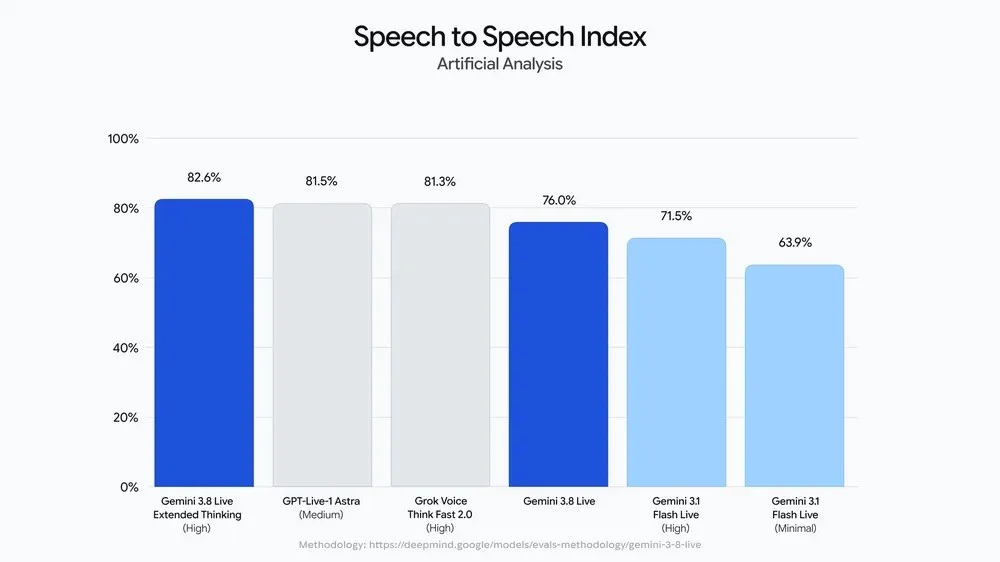
Google cites a score of 82.6 on Artificial Analysis’ Speech to Speech Quality Index, which it says puts the model first overall. It also reports 68.6% on τ-Voice for agentic task completion, 35.1% on Sierra’s τ-Voice-banking benchmark, and 97.7% on Big Bench Audio. Those results cover different aspects of speech and task performance, so they shouldn’t be read as one general measure of how well the model will work in everyday use. The company also says it remains competitively priced against other frontier models, though the source doesn’t provide a price comparison.
Benchmarks can help establish a point of comparison, especially for systems that handle both speech and actions. They can’t, by themselves, show how a model behaves in a messy conversation, how often it misreads an ambiguous request, or whether its spoken updates are useful rather than distracting. This is more significant than it looks: for a live assistant, timing and conversational judgment are part of the product, not just presentation around the underlying model.
Visual input and wider language support
The standard Gemini 3.8 Live model focuses on fluid conversation grounded in visual input. It can process images in near real time while tools and API calls run in the background, acknowledging a request and continuing the discussion as those tasks finish. It also supports transitions among 97 languages during a conversation. That combination points to a system intended to handle exchanges that move between what a user says, what they show, and what the assistant can do with connected tools.
The claim of near real-time image processing is relevant because visual questions can depend on details that aren’t easy to describe aloud. A user might want to discuss something they’re looking at while the system performs a related task. Still, the source doesn’t describe the limits of the visual input or explain how the model handles uncertain interpretations. The promise is a more continuous exchange; the practical value will depend on whether the assistant can keep context as the conversation changes direction.
Support for transitions among 97 languages could also make a single conversation more flexible. That doesn’t establish equal quality across every language, and Google hasn’t supplied that detail here. But it does suggest the model is designed for exchanges where a user may switch languages without starting over. Here’s the thing: breadth of support is useful only when the system can follow the conversation well enough to preserve the meaning of the request.
The test is in everyday use
Google says the base model is built for scale and cost efficiency, and places second in the Speech Agent Arena. Gemini 3.8 Live will power Search Live in AI Mode. The practical test will be whether background work and live narration make voice search useful for tasks that take more than a single question. For Google, that means showing that an assistant can hold a coherent exchange while it searches or acts, rather than simply adding speech to a sequence of separate requests.
That said, a smooth conversation can make an answer feel more convincing without making it more reliable. Users will still need clear results, useful explanations, and a way to steer the system when it misunderstands. The new model’s ambition is plain: keep the exchange alive while work continues. The hard part is making that continuity earn the user’s confidence.
And yet, the product’s strongest test may be a mundane one: does it save effort on the tasks people already want to do by voice? If the narration stays brief and the background actions work as intended, longer requests could feel less cumbersome. If not, the extra talk may only make the wait more noticeable. The answer will emerge in ordinary use, one request at a time.
Discussion
Sign in to join the discussion.