EKS fleets average 8% CPU and 5% GPU utilization. Rightsizing, workload sharing and smarter Spot placement can turn idle capacity into useful compute.
EKS has a broad menu of compute options, but that breadth hasn’t translated into efficient use of the hardware. The 2026 State of Kubernetes Optimization Report points to a practical problem for AWS teams: production clusters are provisioning far more capacity than their workloads consume, even as their footprints grow.
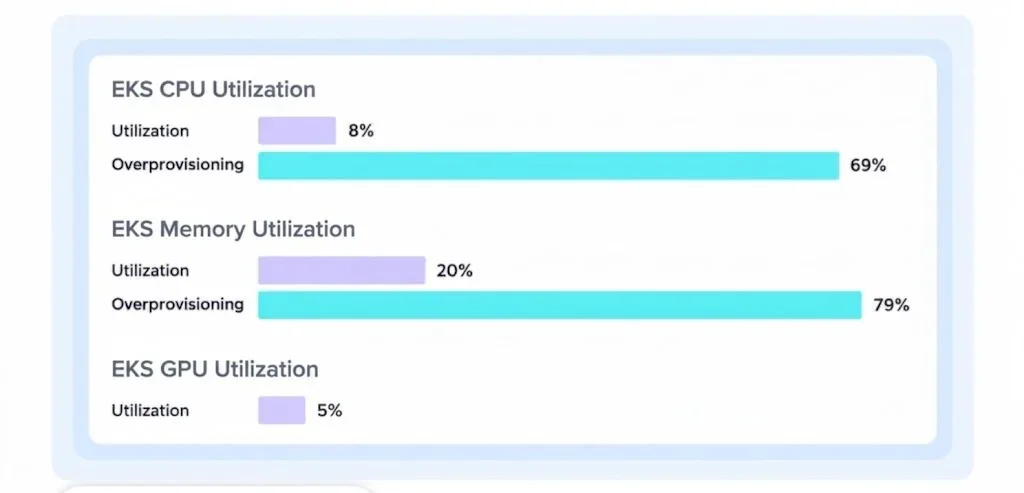
Across tens of thousands of clusters and millions of compute resources on AWS, Azure and GCP, average CPU utilization fell from 10% to 8% in 2025. Memory utilization dropped from 23% to 20%. At the same time, CPU overprovisioning rose from 40% to 69%, and memory overprovisioning reached 79%.
The report measures production clusters before automated optimization was enabled, offering a view of how capacity was actually used in daily operation. Its figures suggest that adding more instance types and autoscaling features won’t solve the underlying mismatch between Kubernetes resource requests and application demand.
Autoscaling follows requests, not consumption
Karpenter helps EKS teams provision EC2 capacity in response to pending pods, without relying on fixed node groups. That flexibility can speed up scaling and broaden instance choices. But Karpenter, like other Kubernetes autoscalers, must work from the resource requests Kubernetes gives it. It doesn’t automatically know how much CPU or memory a running service actually uses.
Consider a pod that requests 4 vCPUs and 8 GiB of memory but uses only 500 millicores of CPU and 1.5 GiB of memory at peak. The scheduler still needs a node that can honor the request. In effect, the request becomes a reservation, whether or not the workload uses it.
Teams often set these values conservatively to avoid CPU throttling, latency problems or out-of-memory evictions. A buffer that prevents trouble can remain in place long after the original concern has passed, then spread through Helm charts and Terraform templates. The result can be a cluster that satisfies its declared scheduling requirements while carrying much more capacity than the applications need.
That gap matters especially for organizations managing their own EKS nodes: they pay for unused headroom. Karpenter can choose and provision nodes efficiently against the requests it receives, but teams still need to keep those requests aligned with measured production behavior.
GPU capacity makes idle time expensive
GPU utilization averaged just 5% across the report, including on EKS. In practical terms, that leaves most GPU capacity unused at any given time. This is a more expensive form of waste than idle CPU: an unused accelerator can cost dollars per hour.
The report says AWS increased H200 Capacity Block prices by 15% in January 2026, citing supply and demand. With accelerator capacity expensive and difficult to secure, dedicating a full GPU instance to an inference service with intermittent requests can leave organizations paying for long quiet periods.
Sharing accelerators through time-slicing, dynamic allocation and bin-packing offers one way to increase useful work per GPU. ALLEN Digital, an edtech platform, ran seven machine learning models on AWS, including BGE-M3, LlamaGuard and Multilingual E5 Large. The organization moved from dedicated Amazon SageMaker instances to EKS, where it used GPU time-slicing, automated bin-packing and an even split between Spot and on-demand capacity.
The report says the change cut total compute costs by more than 70% compared with SageMaker, with no compromise in inference latency. The example illustrates why GPU efficiency depends on workload placement as well as instance selection: several models with intermittent demand can share physical accelerators instead of each reserving a dedicated machine.
Spot savings depend on where workloads run
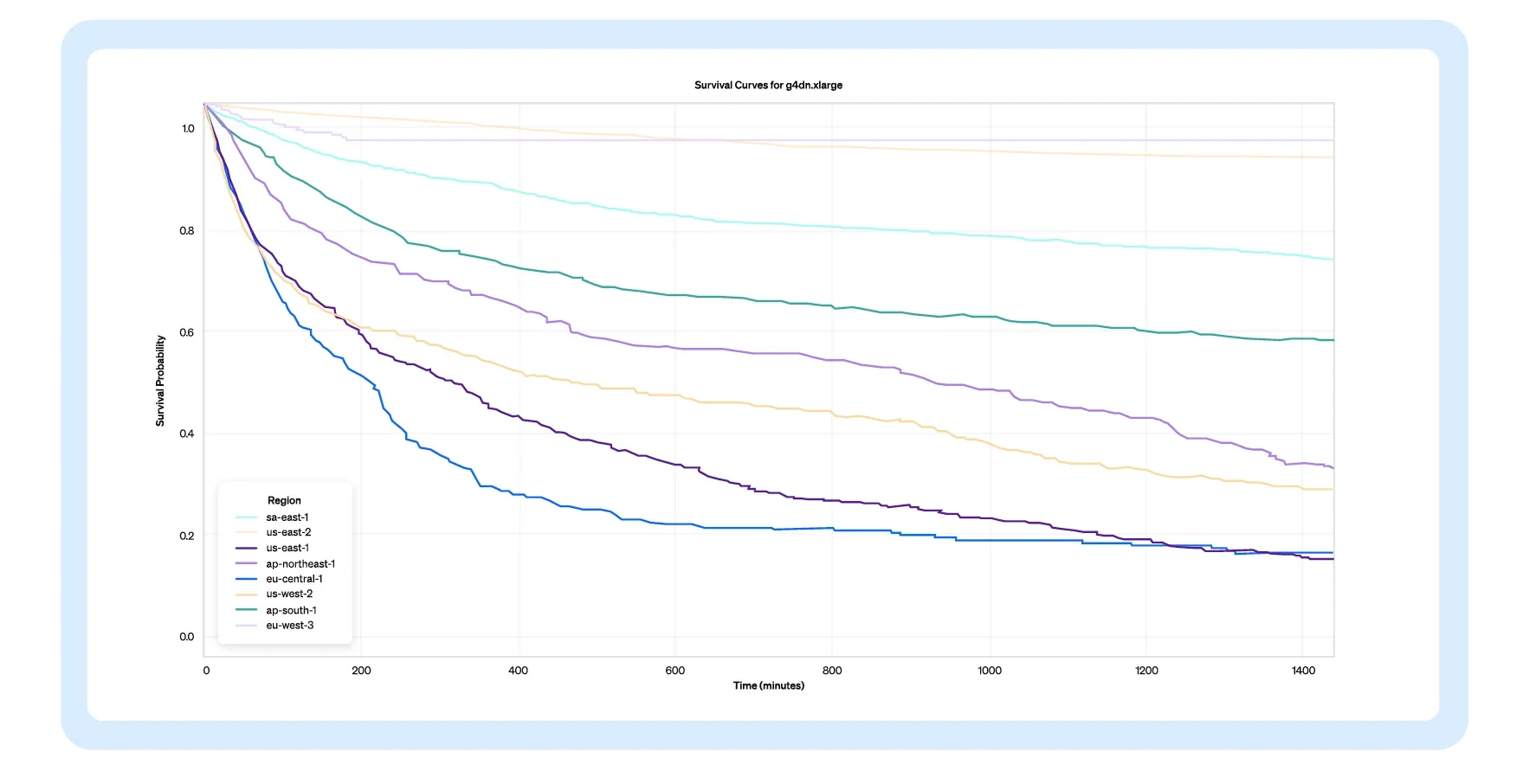
EC2 Spot Instances can cost up to 90% less than on-demand capacity, yet fewer than 2% of GPUs in the report ran on Spot. The short interruption notice is a real operational constraint, but the data suggests that risk differs sharply by region.
For NVIDIA T4 g4dn.xlarge instances, the reported 24-hour survival probability remained above 90% in eu-west-3. In us-east-1 and eu-central-1, it fell below 20% over the same period. Treating Spot as a uniform option across AWS regions therefore misses a major part of the decision: instance availability and interruption patterns vary with location.
Prices can vary just as widely. For p4d.24xlarge A100 instances, Spot prices differed by roughly two to nearly five times among US regions including us-east-1, us-east-2 and us-west-2. The report says shifting workloads in response to market conditions delivered savings of up to 80% against the average Spot price.
Monitoring prices, capacity and interruption risk across regions and availability zones by hand is difficult to sustain. Iterable, a marketing platform, used automated hourly Spot rebalancing across its AWS environment. The report credits that approach with removing 2,000 unneeded CPUs, reducing node count by 10% and cutting compute spend by 75% while the platform handled changes in real-time traffic.
Graviton fits the stateless majority
ARM CPU nodes are growing 3.5 times faster than x86 nodes in Kubernetes fleets, measured from the second quarter of 2024, and now make up 9% of total Kubernetes CPU capacity in the report. That growth aligns with the workload mix: 93% of observed deployments were stateless.
Stateless services, workers and APIs can often run on Linux ARM64 without the persistent storage requirements that complicate some migrations. Graviton can lower per-core costs, but changing processor architecture alone won’t correct oversized pod requests. Rightsizing first, then placing workloads on suitable Graviton nodes, addresses both excess allocation and hardware cost.
More headroom doesn’t guarantee reliability
Platform teams often retain broad resource buffers to protect service-level objectives. Yet the report describes a production environment that averaged 40 to 50 out-of-memory kills per measurement window, sometimes exceeding 80, despite extensive resource padding.
Static buffers can leave quiet services with more resources than they need while fast-growing or memory-leaking workloads continue to run against stale limits. Automated rightsizing can adjust in both directions: reduce CPU and memory allocations where observed use stays below requests, and raise memory limits when a workload shows signs of pressure.
In the reported environment, that approach brought OOM kills close to zero while cutting provisioned CPU by about 50%. The figures make a useful point for operations teams: reliability depends on responding to workload behavior, not simply reserving more capacity everywhere.
Commit to capacity after removing waste
Savings Plans and Compute Reserved Instances can reduce AWS bills, but commitments made against an inflated baseline can preserve the waste at a lower rate. With CPU overprovisioning at 69% in the report, a long-term commitment made before rightsizing could cover resources applications don’t use. The article says manual management and changing workloads can leave as much as 35% of prepaid commitment capacity wasted.
A sound sequence starts with measuring and rightsizing workload requests. Teams can then pack nodes more efficiently, use suitable instance families such as Graviton, and place interruption-tolerant workloads on Spot with regional diversity and on-demand fallback. Once the remaining baseline is clear, commitments can be sized to that demand; the report’s recommended process targets commitment utilization near 98%. A deeper discussion of EKS cost optimization explores the same operating challenge.
The report finds a similar utilization problem across AKS, GKE and EKS. The pattern points to the work of running Kubernetes at scale: resource requests, node placement and capacity choices change as teams, regions and traffic grow. For EKS operators, the durable takeaway is to connect those decisions to ongoing production measurements. More compute options help, but continuous adjustment is what turns that choice into higher utilization and steadier operations.
Discussion
Sign in to join the discussion.