GKE’s automation can manage infrastructure, but teams still need to right-size workloads and match capacity to demand. New utilization data shows where to start.

Google Kubernetes Engine can automate much of the work involved in running Kubernetes infrastructure. Yet a recent report suggests that many GKE workloads still ask for far more compute than they use. The gap points to a practical limit of managed infrastructure: GKE can provision capacity to meet declared requirements, but teams must decide whether those requirements reflect production behavior.
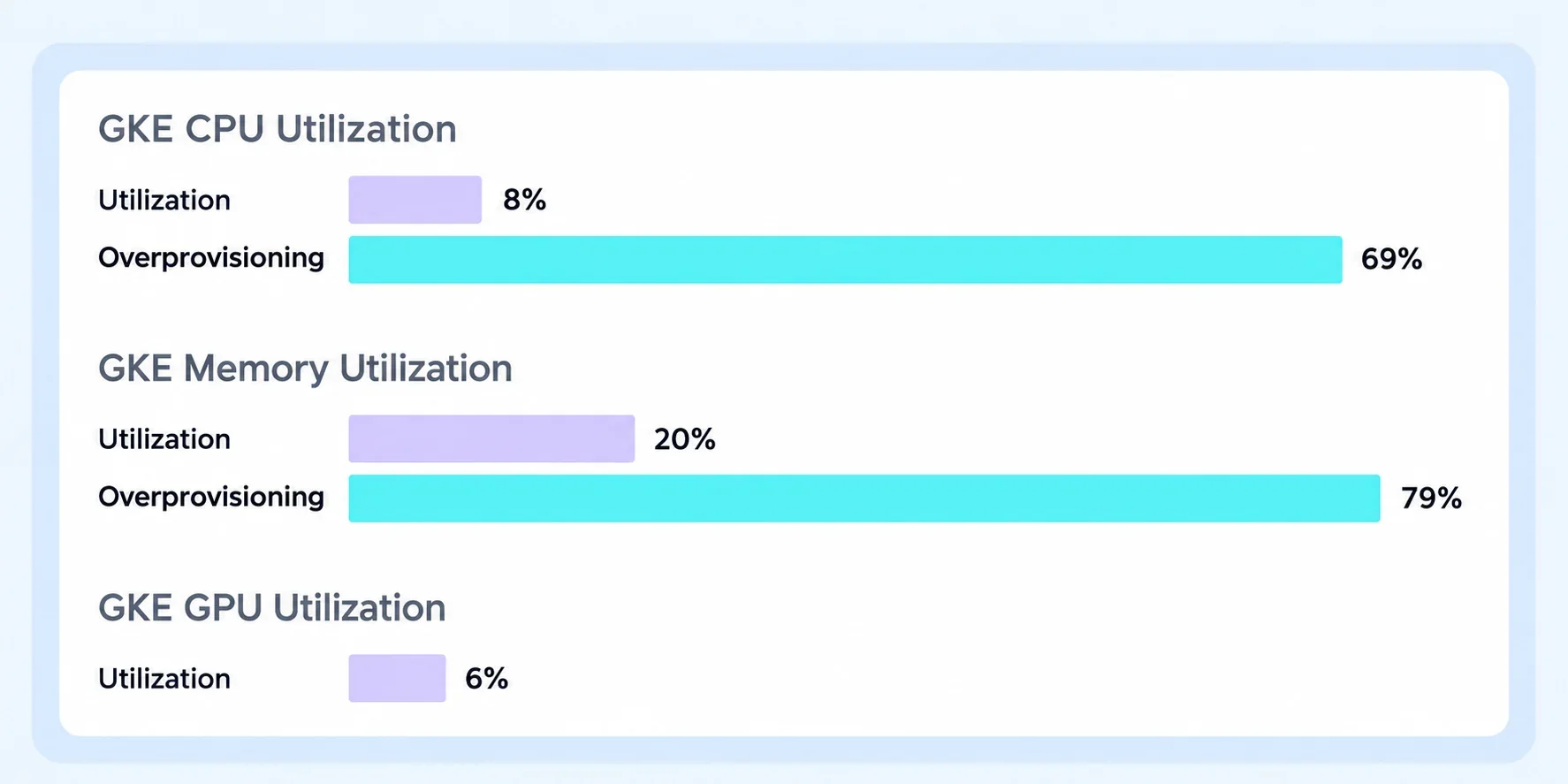
The 2026 State of Kubernetes Optimization Report measured average GKE CPU utilization at 8%, memory utilization at 20%, and GPU utilization at 6%. It also found CPU overprovisioning in 69% of GKE clusters and memory overprovisioning in 79%. Those figures came from measurements of more than 23,000 Kubernetes clusters and millions of compute resources across AWS, GCP, and Azure, collected before automated optimization was enabled.
Google’s experience building and running Kubernetes at scale has shaped GKE features such as Autopilot, which takes on parts of infrastructure management. That expertise can simplify cluster operations, but it can’t determine whether an application’s four-CPU request is justified. The resource values teams declare remain a major factor in how much capacity the platform provisions and, in some cases, how much they pay for.
Start with workload requests
Low utilization can look like a node-pool problem, but changing node capacity won’t correct a mismatch between what a workload requests and what it consumes. Consider a service configured for two CPUs and 2 GiB of memory that typically uses about 500 millicores and 700 MiB. Kubernetes schedules around the declared request, not the application’s usual footprint.
The consequences vary by GKE operating mode. In Autopilot, oversized requests directly raise the resources billed for a workload. In Standard, they can also lead the cluster to provision more node capacity than the application needs. That makes workload requests a useful first target, with potential benefits for both the workload footprint and the underlying fleet.
Requests should still leave room for normal production variation. The problem is when a deliberately cautious setting stays in place after the conditions that prompted it have changed. Teams can compare current requests with actual CPU and memory use over a representative period. For applications with weekly traffic patterns, a seven-to-14-day window provides more context than a snapshot from a quiet hour.
A measured rollout can limit the risk of changing those settings. Start with a small set of workloads, observe how they behave after requests are adjusted, and extend the approach when the results hold up. Reducing requests across hundreds of deployments at once makes it harder to identify the cause if performance changes.
Keep autoscaling signals clear
Vertical Pod Autoscaler (VPA) can adjust workload requests, while Horizontal Pod Autoscaler (HPA) can change the number of pods. Combining them requires care when HPA scales on CPU or memory: VPA changes a request, the HPA’s utilization calculation shifts, the pod count changes, and that new behavior becomes input for VPA. The resulting feedback can make scaling harder to reason about.
One option is to run VPA in recommendation-only mode before applying changes automatically. Teams that need both systems can also base HPA decisions on application-level signals such as request rate or queue depth. That keeps the scaling signal closer to the work the service is doing.
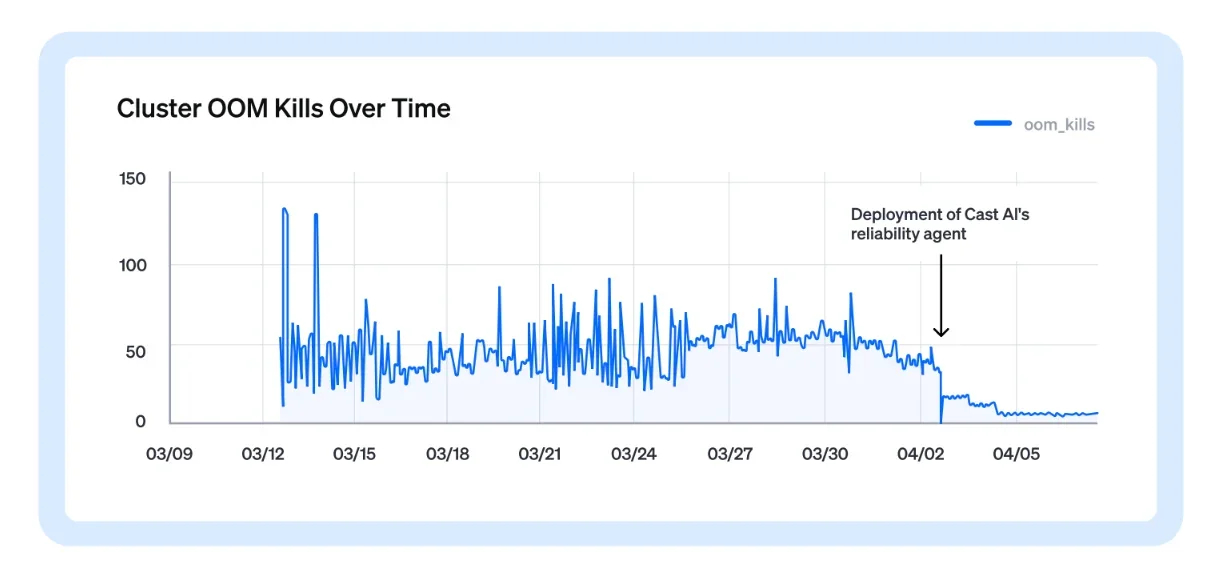
The report offers evidence that rightsizing can reduce resource allocations without worsening every reliability measure: automated rightsizing cut provisioned CPU by roughly half while reducing out-of-memory kills to near zero. That result supports using observed workload behavior to distinguish useful headroom from unused padding. It doesn’t mean every application should receive smaller requests without validation.
Let accurate requests guide the node fleet
On GKE Standard, right-sizing pods is only part of the work. The next step is to make sure the underlying Compute Engine fleet matches the workloads it serves. Cluster Autoscaler adjusts capacity as demand changes, while Node Auto Provisioning can create node pools when a workload needs machine types that aren’t already available.
These tools respond to the requests Kubernetes sees. If ten services each ask for twice the CPU they usually consume, autoscaling has no basis for treating those requests as excessive; it provisions to satisfy them. Accurate requests give autoscaling and node consolidation a better starting point, helping teams pack workloads more efficiently and remove capacity that is no longer needed.
That distinction makes Standard both more flexible and more hands-on. Practitioners can choose and manage the nodes, but they also bear responsibility for unused capacity. In Autopilot, GKE takes on more of the infrastructure management, while workload requests remain a direct cost lever.
Match interruption tolerance to Spot capacity
Once the baseline reflects typical demand, teams can decide whether every workload needs on-demand capacity. GKE Spot VMs can lower costs for workloads that can withstand interruption. Google’s Spot model gives roughly 30 seconds of preemption notice, so a workload needs an interruption plan before it moves to this capacity.
Batch jobs, CI/CD runners, replicated stateless services, and machine-learning training that saves checkpoints are plausible candidates. Production setups also need suitable disruption budgets, termination handling, and an on-demand fallback for times when Spot capacity isn’t available. Without those protections, a capacity saving can leave a workload unable to run when it needs to.
A mixed approach can assign predictable workloads to dependable capacity and let interruption-tolerant jobs use Spot when available. That places Spot within the broader capacity plan: first establish what workloads need, then decide which part of that demand can tolerate interruptions.
Get more work from GPUs and CPUs
Some compute inefficiency comes from workload sizing; some comes from choosing how expensive hardware is shared. The report put average GKE GPU utilization at 6%, with substantial variation during the day, and found GPU sharing was still relatively uncommon. For inference workloads that use only part of a GPU, sharing or partitioning may allow multiple workloads to use the same physical device more effectively.
In one production example in the report, seven models moved to GPU time-slicing alongside improved bin-packing and Spot usage. The change cut costs by more than 70% compared with the previous platform while maintaining latency. The useful measure here is whether expensive hardware completes more work at the required performance, not simply whether a utilization percentage rises.
CPU architecture is another option for suitable workloads. ARM accounts for about 9% of the Kubernetes CPU fleet and has grown 3.5 times faster than x86 since the second quarter of 2024. GKE offers ARM choices including T2A and Google’s Axion-based C4A and N4A families.
Migration can begin with a small set of scale-out applications that support linux/arm64. Teams can compare performance and cost before expanding. A cheaper processor won’t correct an inflated resource request, so workload sizing still comes first.
Set commitments after finding the baseline
Pricing commitments make more sense once teams understand the capacity their workloads consistently need. GCP’s Sustained Use Discounts apply automatically to eligible Standard node usage. Committed Use Discounts, by contrast, require a deliberate commitment against a baseline. Committing while that baseline includes avoidable overprovisioning can lock in spending for capacity the workloads don’t need.
A practical sequence is to bring requests closer to production use, tune the node fleet around those requests, assign interruption-tolerant work to Spot where appropriate, and improve use of GPU or ARM capacity when workload needs support it. Then teams can set commitments against the remaining baseline, with burst demand handled separately where the workload permits.
GKE’s automation addresses difficult infrastructure tasks, but the utilization figures show that platform expertise alone doesn’t settle how much CPU, memory, or accelerator capacity an application requires. That judgment depends on workload behavior and the operating requirements teams need to preserve. Small, observed changes offer a concrete way to improve efficiency while keeping production performance in view.
Discussion
Sign in to join the discussion.