As cloud-native applications become increasingly data-driven, it's vital to prioritize data freshness alongside traditional health checks for optimal performance.
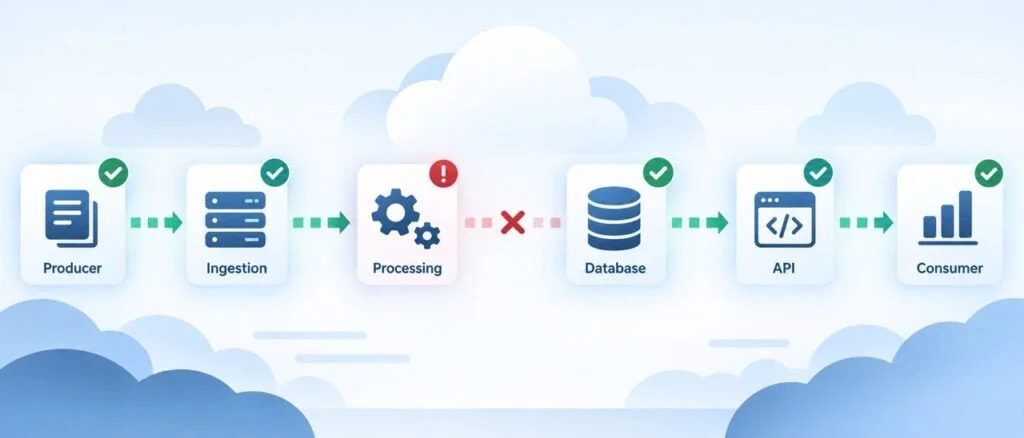
Understanding the Disconnect Between Service Health and Data Freshness
In the realm of cloud-native applications, a fully operational service doesn't guarantee that the data it provides is up-to-date. Often, the application may continue running smoothly, maintaining connections with databases and completing requests, while users experience outdated or stagnated information. This discrepancy highlights a critical issue: service health and data freshness must be assessed together to ensure user reliability.
A Hidden Risk: Healthy Components, Stale Data
Consider a common workflow: a Producer generates data, which flows through Ingestion, Processing, Database, and then to the API that delivers it to the Consumer. Even if the producer halts its updates, all other components may still function normally, returning the last known values even without new data. This situation can give the illusion of a healthy service, while in reality, the data updates have ceased.
Integrating Freshness Into Health Metrics
To tackle this problem, it's essential to incorporate data freshness into the application’s health model. By identifying how frequently data should be updated and comparing that to the latest successful update, teams can assess whether the data remains valid for users’ needs. For instance, if updates are expected every 30 seconds, a single delayed update may not be significant. However, if multiple cycles pass without new data, the application should flag this condition to signal a potential issue.
Recognizing Intermediate States of Data
Not every delay in data freshness signifies a full outage. It's critical to acknowledge varying states of data health. For instance, if an upstream source encounters delays, service restart may not solve the underlying issue. Instead, applications should transition from a healthy state to a degraded one, gradually recognizing the risk of data becoming stale. This classification allows diverse consumer responses—such as dashboards displaying the last known value marked as delayed—while still providing value during transitional states.
Monitoring Data Flow and Freshness
Cloud-native platforms excel in providing visibility into infrastructure. However, data-intensive applications require a focused lens on data flow. Key indicators include:
- Last Successful Update: When was the most recent data received?
- Data Age: How old is the newest data being served?
- Expected Frequency: How often should updates occur?
- Processing Lag: Is information moving slower than expected?
- Duration in Degraded State: Has the application experienced a temporary delay or a persistent issue?
By collecting insights from these metrics, teams can swiftly investigate potential bottlenecks rather than troubleshooting seemingly healthy systems.
Avoiding Alert Fatigue in Freshness Monitoring
Once data freshness becomes a measurable parameter, there's a risk of overwhelming teams with alerts. Not every missed update should trigger immediate action; minor delays occur naturally in network operations. Teams should implement a severity and duration framework for alerts, activating high-priority notifications only if a delay persists beyond acceptable thresholds. The goal should be to generate meaningful alerts that provide useful information rather than noise.
Embedding Freshness in System Design
Integrating data freshness monitoring early in the design phase of applications can significantly strengthen data reliability. Producers must supply timestamps or sequence order, while processing layers should expose their latest activities. Each API should contextualize the currentness of the data it serves. This comprehensive approach ensures that as architectures grow progressively complex, the integrity of data flow remains transparent, indicating when delays may be happening upstream.
Redefining Service Health
Traditional checks like liveness and readiness only address part of the health equation. For data-centric applications, it’s just as vital to understand whether the information is still current enough for users to trust. Instead of merely relying on existing health checks, expanding the health model to include data validity creates a more comprehensive monitoring system. Ultimately, healthy services must possess the ability to recognize when their data quality falters, ensuring that users can rely on the information they receive.
Taking a holistic approach to health checks, which includes monitoring both infrastructure uptime and data validity, aligns more closely with user expectations and needs. This mindset shift can enhance user experience and optimize application performance across the board.
Discussion
Sign in to join the discussion.