Dedicated clusters can reduce risk for workloads with distinct access, job, or scaling needs, provided teams keep every cluster on a shared, automated baseline.
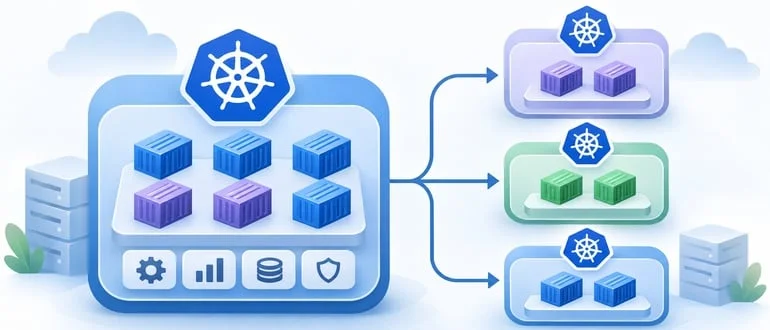
Separate Kubernetes clusters make sense when a workload needs a real boundary from production. The trade is straightforward: stronger isolation and independent change cycles in exchange for more platform components, upgrades, policies, and on-call work.
At a streaming platform, test environments moved off a shared production cluster to dedicated clusters. Earlier, at Lucid Motors, a fleet of 34 clusters was managed through one GitOps control plane. Those experiences point to a practical rule: share clusters by default, and create dedicated ones when the workload’s risk or operating needs justify the added overhead.
When a shared cluster becomes a risk
The case for separation often has less to do with raw performance than with boundaries. Test workloads inside a production cluster share its control plane and may share its nodes and network. A faulty test configuration can therefore affect production infrastructure.
Network access can blur the boundary further. Test environments may need exceptions that let them reach services accessible from production. Those rules can linger after their original purpose is forgotten. Moving test workloads out made it possible to remove one such firewall exception.
Scheduled jobs, schema migrations, and queue workers create another hazard. A mistaken label selector can send a test job against production resources, or a production job against test resources. Separate clusters reduce the chance that this class of configuration error crosses environments.
Different release rhythms also matter. Test environments change frequently; production changes more cautiously. Keeping both in one cluster can constrain test work or expose production to changes it doesn’t need.
Isolation brings an operating bill
Each cluster needs its own platform layer: metrics and logging agents, ingress, DNS, certificate controllers, and security agents. It also needs spare capacity for scheduling. In a small environment, that supporting footprint can take a noticeable share of available resources.
Operations multiply too. Every cluster adds a control plane to upgrade, deprecated APIs to find, and add-on versions to align. Network policies, admission rules, and access roles must be kept consistent across the fleet; manual copying invites drift.
Monitoring and incident response expand with the cluster count. New clusters bring more dashboards, alerts, and data sources. When staging moved, its metrics began coming from a separate source, adding another place for operators to look.
Use explicit criteria to decide
A workload is a candidate for its own cluster when at least one of these conditions applies:
- A mistake in the workload must be unable to reach production.
- It needs network access or permissions that production shouldn’t have.
- It runs singleton or stateful jobs that need stronger safeguards against duplicate execution.
- Its change rate or scaling pattern differs sharply from nearby workloads, as with load generators.
- A regulatory or data residency boundary applies.
When none of those conditions holds, a shared cluster is usually the simpler choice. Writing the criteria down turns a request for a dedicated cluster into a short, consistent review.
Make migrations controlled and reversible
Keep scheduled jobs, migrators, and queue workers disabled in the new cluster until cutover. That prevents the same singleton work from running in both places. Before moving, identify which components can safely run twice: stateless request-serving services may tolerate overlap, while stateful components often need a separate plan.
For request-serving workloads, switching DNS while retaining the same URL can keep the change invisible to users and test suites. It also gives teams a simple rollback path: point DNS back to the old cluster. Remove special network exceptions from the old environment only after nothing there depends on them.
Keep every cluster on one baseline
A larger fleet is manageable when clusters are generated from shared configuration instead of maintained as separate snowflakes. At Lucid Motors, each of the 34 clusters had a short configuration file. Every cluster received the full platform baseline unless its file explicitly opted out of a component, and reviewers assessed exclusions alongside the configuration.
CI rendered every chart against every cluster’s configuration on each change, giving reviewers a view of the fleet-wide effect before a merge. Upgrades followed a set sequence—development, staging, then production—with deprecated API scans across all clusters before each step.
That approach still costs more than operating one cluster. It costs less than maintaining 34 unique setups. Before creating a dedicated cluster, teams should be able to build it from the same reviewed baseline as the rest of the fleet; if they can’t, the baseline needs attention first.
Discussion
Sign in to join the discussion.