Researchers analyzed 170 years of financial journalism and found rising alarm can help flag bubbles, though estimates vary and cannot time a market downturn.
Media alarm can be a useful market signal, even when the press is usually too quick to predict a crash. Researchers at London Business School and the University of Cambridge put the chance that AI stocks were in a bubble as high as 97% in September, before a sell-off erased trillions of dollars from technology stocks.
The estimate comes from Crying Wolf, a study by London Business School finance professor Marco Grotteria and University of Cambridge researchers Afonso Monteiro and Constantine Yannelis. Their work, highlighted by London Business School on Wednesday, asks whether the language of financial journalism can flag speculative bubbles before they break.
The researchers fed nearly 170 years of financial coverage into AI models. They examined 795,964 articles published by The Economist from 1843 to 2013, of which about 486,000 concerned financial markets, then extended their index through September 2026. The September reading matched or exceeded the level reached at the dot-com peak in March 2000. The Nasdaq later fell roughly 77% from that peak.
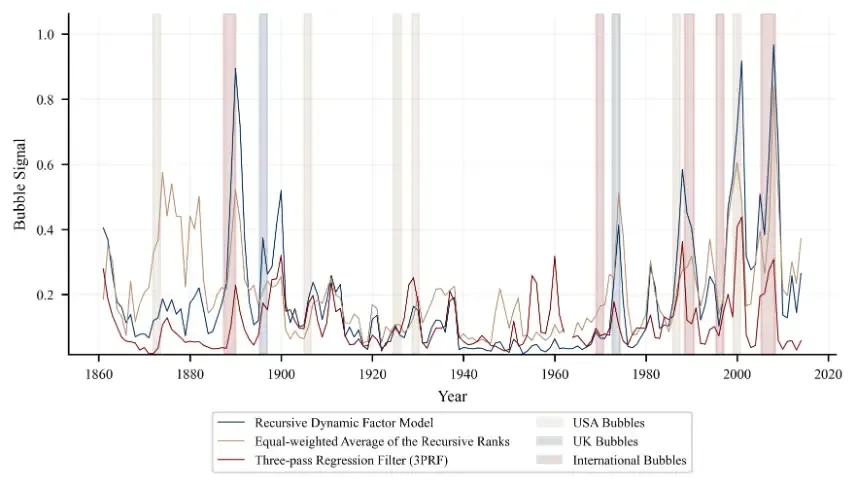
The method looks beyond how often journalists use the word “bubble.” It tracks language about overheated speculation, stretched valuations, regulatory concerns and investor euphoria, then compares monthly readings with 22 documented bubbles across 10 countries. That breadth is useful, though the study doesn’t establish that press coverage causes market declines—or that a high reading can time one.
When warnings become a signal
Financial journalism has a false-alarm problem. On average, its coverage implied a 20% chance of a major market crash within six months; such crashes actually occurred 5.7% of the time. Taken at face value, that gap makes any single warning hard to trust.
Here’s the more revealing result: the researchers found that the change in alarm mattered more than its usual level. During 74% of comparisons between bubble months and ordinary months, their index was higher during the bubble. For the dot-com episode, that figure reached 94%.
If you’re working in markets, the takeaway is a qualified one. A noisy press can still provide information when its tone shifts sharply from normal. The September AI reading was striking by that measure, but it remains a probability estimate—not proof that a bubble existed or a forecast of when prices would fall.
Discussion
Sign in to join the discussion.