Kubernetes can schedule ML workloads, but declarative lifecycle control is what makes training, evaluation, and deployment observable and recoverable.
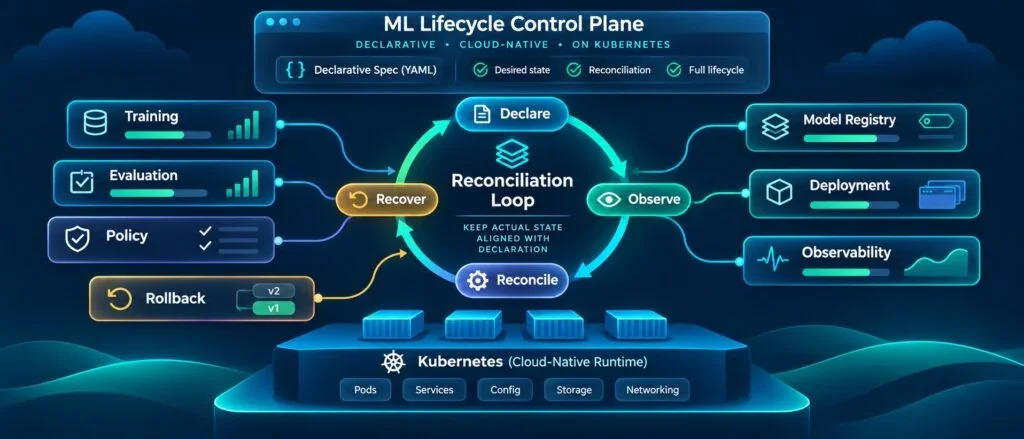
Putting machine learning workloads on Kubernetes solves only part of the platform problem. Clusters can schedule GPU-backed training, run inference services, isolate workloads, and recover containers. The harder step is managing the chain of decisions and artifacts around each model: what was trained, how it was evaluated, which version is serving, and whether it can be rolled back. My read is that a platform earns the Kubernetes-native label when it applies Kubernetes’ operating model to that lifecycle, not simply when its compute runs in a cluster.
That distinction is becoming more visible as AI workloads migrate to Kubernetes, a trend described by Vara Bonthu in a CNCF article about AI platforms converging on Kubernetes. Training jobs and inference services may use Kubernetes resources, while lifecycle management still depends on separate APIs, databases, and custom scripts. The infrastructure is unified; the operational picture often isn’t.
Make the model lifecycle a managed system
Production machine learning is a continuing process, not a row of unrelated jobs. A training run depends on input data, code, and parameters. It produces a model that may need evaluation, registration, and deployment. A deployment, in turn, has a specific model version, rollout policy, health signals, and traffic allocation. Those links matter when teams need to reproduce a result or understand why a release behaved differently.
They also need to survive interruptions. Processes restart, clusters fail, datasets change, and teams hand work across organizational boundaries. If lifecycle state lives only in individual jobs or scattered service records, rebuilding the full story becomes difficult. Treating the lifecycle as explicit state gives the platform a durable record of intent, relationships, progress, and results.
Kubernetes offers a useful pattern for managing that state: declare the desired outcome, observe what’s happening, and repeatedly act to close the gap. Controllers already apply this reconciliation model to infrastructure. Custom resources and controllers can extend it to machine learning concepts such as training runs, evaluations, model versions, and deployments.
Reconciliation makes rollouts observable
Consider a request to send 10% of production traffic to model version 42. The desired state is clear, but the platform still has to create or update runtime resources, check health, and report whether the rollout is progressing. If the model currently receives no traffic, a controller can start a canary rollout and monitor the relevant signals. The control loop keeps working until the requested state is reached or a condition requires attention.
Status should explain what’s happening in terms platform users can act on. A rollout might be waiting for capacity, blocked by a policy check, or unhealthy. That’s more useful than a generic report that a pod failed, because it ties the problem to the lifecycle operation and its intent. With explicit conditions, automation and people can see whether a resource is pending, progressing, ready, degraded, or blocked.
The same model can support gradual changes across clusters. A control plane can spread a rollout over time and stop when signals indicate trouble, limiting how far a bad change propagates. The value comes from connecting desired state to ongoing observation and action, rather than relying on a script that runs once and leaves operators to infer the result.
Keep the control plane focused
A shared lifecycle model doesn’t require one platform to rebuild every tool. Training, data processing, and inference each have specialized execution engines; those tools can continue doing the work they’re designed for. The control plane describes intent, relationships, policies, and status. Adapters translate that intent into runtime-specific resources, while results flow back into the shared model.
This division gives users a consistent way to manage work without forcing every workload through the same execution path. It also makes the lifecycle contract more durable than any particular training engine or serving runtime. As those components change, the platform can update its adapters while preserving the objects and workflows users rely on.
There’s a practical limit to what belongs in Kubernetes. A resource should represent lasting intent that a user or automation needs to manage and observe, such as a model deployment. Temporary function calls and internal implementation details don’t automatically need their own resource. Large model files, logs, traces, and detailed evaluation results are better suited to purpose-built storage; Kubernetes resources can hold durable references and concise status instead.
Before creating a new resource type, platform teams can ask whether it expresses meaningful user intent, has a lifecycle beyond one process, needs ongoing status tracking, benefits from reconciliation, and can support a stable API contract. If those conditions don’t apply, another representation may fit better.
Build around contracts that can outlast tools
Paul Zimmerman points to experience with Uber’s ML platform, Michelangelo AI, whose modular control plane has been released as an open-source project. The architectural lesson is that the lasting abstraction is the contract connecting training runs, models, evaluations, and deployments—not a single engine or workflow implementation.
That distinction also applies as platforms take on generative and agentic AI. Alongside models, teams now manage prompts, tools, policies, benchmark suites, and traces. The artifacts vary, but the operational questions remain familiar: what did the system run, which versions and inputs did it use, what happened, did it meet evaluation and policy requirements, and can the result be reproduced, promoted, or rolled back?
Consistent lifecycle objects make those questions easier to answer because they link the relevant inputs, outputs, and deployment state. Metrics and logs can point to the operation that failed—for example, an evaluation for a model candidate—instead of leaving teams to reconstruct the connection from low-level infrastructure events.
Shared patterns matter more than a universal API
Kubernetes has supplied a common foundation for running AI workloads. The next opportunity is to develop common ways to manage their lifecycle, without forcing varied workloads into one rigid MLOps API. Useful areas for shared work include lineage and lifecycle relationships, status conventions, portable workload definitions, identity and policy boundaries, evaluation and promotion workflows, and observability across compute, accelerators, and storage.
For platform builders, the practical test is straightforward: can users declare what they want, see what the system has actually done, understand the connection between a model and its inputs, and recover or roll back when something goes wrong? If those answers still depend on scattered scripts and service-specific records, Kubernetes may be hosting the ML platform without managing its lifecycle.
The next stage of Kubernetes adoption is therefore operational. A platform can connect specialized execution tools through explicit, observable state and continuous reconciliation. That gives teams a clearer path from a training run to a production decision—and a stronger basis for managing the new artifacts that AI systems will add.
KubeCon + CloudNativeCon is scheduled for November 9–12 in Salt Lake City. Event details and registration are available from the Linux Foundation.
Discussion
Sign in to join the discussion.