Circle and ACI Pilot USDC Settlement on Colombia’s Existing Banking Rails
Oct 27, 2026 · 808 views
Circle and ACI will test USDC settlement alongside Colombia’s instant payment network, exploring how stablecoins can fit banks’ existing systems.
Circle’s test: put USDC on banks’ existing rails
The interesting part of Circle’s Latin American push is the integration strategy. It’s working with payments technology firm ACI Worldwide to add USDC settlement to existing banking infrastructure, beginning with a pilot in Colombia. The companies announced the collaboration Tuesday.
The pilot combines Circle’s USDC infrastructure with ACI Connetic, its cloud-based payments orchestration platform. The aim is to show financial institutions how stablecoin settlement can operate alongside traditional payment systems. That focus speaks to a practical concern for banks: they need to understand how a digital dollar would fit into treasury management, governance and settlement processes they already run. A technical demonstration can help clarify that fit, though it can’t answer every operational question.
For banks, compatibility may matter more than another broad claim about what stablecoins could do. A payment system has to connect with existing workflows, account controls and settlement procedures before it can become useful in routine business. Similar integrations typically involve questions about who initiates a transfer, how institutions reconcile it and what happens when a payment needs review. The announcement doesn’t describe those details, so the pilot’s scope will matter as much as its headline ambition.
ACI built the central infrastructure behind Bre-B, Colombia’s interoperable instant-payments network. The pilot will explore how USDC could work with that real-time, account-to-account system as part of what the companies describe as a multi-rail ecosystem. The result is still a pilot, so it won’t establish how widely banks will adopt the model. But it puts the practical question on the table: can a digital dollar join established payment flows without forcing institutions to replace them?
That question is more significant than it looks. Banks often have reasons to keep familiar payment systems in place, even when a newer technology promises faster or more flexible settlement. Connecting rails could let institutions test a new form of settlement while retaining existing processes around it. Whether that reduces friction in practice is precisely what a pilot should help establish.
The companies’ announcement frames the effort as a way to bring regulated stablecoins into workflows banks already trust. “The conversation around stablecoins is moving from possibility to practicality,” said Craig Ramsey, ACI’s global head of account-to-account payments. That’s a useful description of the pitch, but it’s still a pitch; the pilot has to show that the arrangement works for participating institutions.
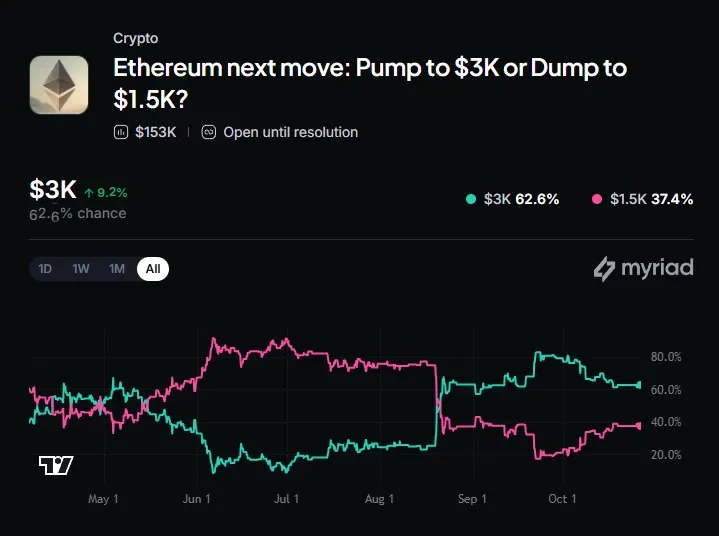
Myriad: Where does ETH go next? Click to make your prediction.
Why Colombia, and why now?
Colombia is a sensible place to run the test. The article points to substantial cross-border remittance volumes and familiarity with dollar-denominated savings as a hedge against inflation. Those conditions give a digital dollar a plausible use case, though they don’t tell us whether banks or customers will choose it. A potential need is only the starting point; the payment has to be accessible, understandable and useful within the channels people already rely on.
Cross-border payments can involve several institutions and steps, making settlement arrangements a consequential part of the customer experience. A stablecoin could offer another way to move dollar value between participants, but its usefulness depends on how it connects to local payment systems and bank operations. The pilot’s focus on Bre-B and existing infrastructure gives it a concrete setting in which to examine that connection. Still, the announcement doesn’t say how customers would access the service or what use cases the pilot will prioritize.
Circle is also building on an existing regional presence. It has expanded into dozens of emerging markets and previously gained a Latin American foothold when Argentina’s Mercado Pago added USDC. Circle has pushed into dozens of emerging markets, while Mercado Pago’s USDC addition marked an earlier regional step. Together, those moves show a strategy that reaches beyond crypto-native users and toward firms with established financial relationships.
Circle’s chief commercial officer, Kash Razzaghi, said financial institutions across Latin America are looking at how stablecoins can support payment changes “within the infrastructure they already use.” That captures the pitch: USDC as a link between traditional finance and the digital economy, with banks keeping the systems they already operate. If you’re working in this space, the distinction matters: a stablecoin can be available without becoming part of a bank’s everyday payment process.
ACI’s platform is designed to support other payment networks and digital-asset providers over time, even though this pilot uses USDC. That could give the project relevance beyond a single asset if the underlying integration proves useful to institutions. (And this is the part most people overlook.) A platform’s ability to connect providers doesn’t show that banks will want to connect them, or that customers will use the resulting services. Operational fit first.
What the pilot can—and can’t—show
For Circle, the project is a bid to place its stablecoin inside mainstream financial infrastructure. The test could help show whether USDC settlement can coexist with a real-time payment network and the processes banks already use. That’s a concrete step, but the announcement doesn’t establish that the pilot will lead to a wider rollout, or explain what measures the companies will use to judge its results.
The numbers here are underwhelming in one sense: there’s no disclosed scale, adoption target or timetable in the information presented. That leaves readers with a strategic direction rather than evidence of demand. Even a successful technical connection would leave questions about participation, ongoing operations and customer uptake.
And yet. For financial institutions weighing stablecoins, a working connection to familiar payment infrastructure may be more persuasive than another abstract promise. If the pilot can show that the two systems operate together in a way banks can manage, it’ll give Circle and ACI a more practical case to make. If it can’t, the broader ambition will remain just that: an ambition.
Keep up with the story
Circle’s push into Colombia is part of a wider shift in how USDC is used for payments and settlement. The Daily Debrief newsletter offers a daily roundup of top stories, original features, a podcast and videos. More than 72,000 readers have signed up.
Share the article on X, LinkedIn, Facebook, Reddit or by email, or copy its link. You can also save it by creating an account, or add Decrypt as a preferred Google news source.
The page also includes a horizontal offers widget.
Discussion
Sign in to join the discussion.