Ripple will provide Robinhood with RLUSD, treasury software and institutional financing and trading services, extending its reach across the company’s crypto business.
Ripple is selling Robinhood more than a stablecoin
The bigger story is how many parts of Robinhood’s crypto business Ripple now touches. RLUSD, Ripple’s dollar pegged token, went live Tuesday on Robinhood Chain and the Bitstamp exchange. It’s expected to arrive in Robinhood’s main app later this year, according toThe deal reaches into operations and institutional finance
Robinhood will use Ripple Treasury to manage global cash operations, including payments, cash flow forecasts, risk management and intercompany netting. That last task offsets amounts owed between a company’s own divisions, reducing the number of payments that need to be made. These are routine but consequential functions: the software handling them can affect how quickly a company sees its cash position and coordinates funds across its business. The announcement doesn’t spell out how much of Robinhood’s treasury work will move onto Ripple’s system, so the scale of that operational role remains unclear. The arrangement also puts RLUSD to work behind the scenes. Robinhood plans to use the token on the XRP Ledger—the blockchain associated with XRP—to settle trades for institutional clients on Bitstamp. Settlement is the point at which a large trade is finalized and paid for. A stablecoin can provide a way to transfer value on a blockchain, while the ledger supplies the transaction record; the practical test is whether that process fits the exchange’s existing workflows and client needs. This is more significant than it looks: if RLUSD becomes part of settlement, its role won’t depend only on retail users choosing to buy it.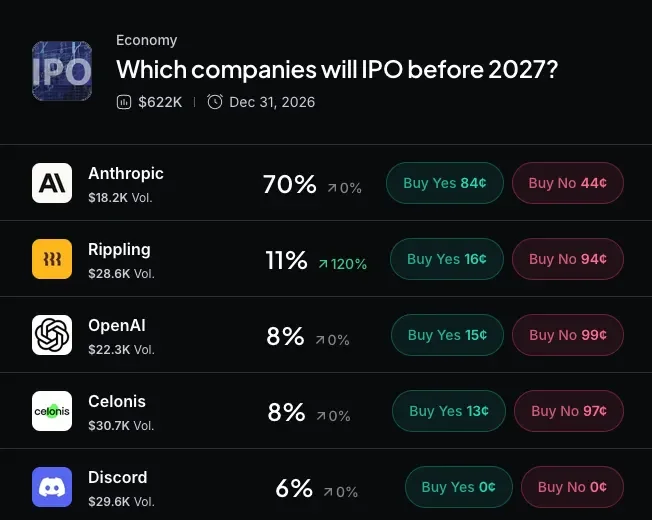 Myriad: Which company will IPO next? Click to make your prediction.
Ripple’s other businesses extend the partnership further. Ripple Prime, which lends to and clears trades for hedge funds and other large institutions, already offers Bitstamp lending and margin financing across roughly 20 digital assets. Ripple bought the business, then known as Hidden Road, for $1.25 billion in a deal announced in April 2025. Financing and clearing can matter as much as access to an asset for institutional clients, since firms often need services around a trade as well as a venue to execute it. (And this is the part most people overlook.) The agreement connects Robinhood to a wider set of services through Bitstamp, not just to Ripple’s token.
Prime clients can also trade crypto at Bitstamp’s spot prices. Perpetual futures—contracts tied to a coin’s price that don’t expire—are planned for later this year. Robinhood completed its purchase of Bitstamp in June 2025 for about $200 million. The exchange is one of the world’s longest-running crypto exchanges, and most of its trading volume comes from institutions. That institutional base gives Robinhood a channel into a different customer group from the retail users who made its brand. It also means the value of the relationship will depend on whether those clients use the services on offer.
Here’s the point: Ripple is supplying Robinhood with a token, treasury software and institutional financing and trading services. That’s a broader foothold than a new coin listing. Robinhood’s crypto stance has shifted, too. After cutting back its listings during the SEC crackdown on Ripple and other crypto companies, it added XRP for U.S. customers in November 2024. Now Ripple’s software is set to run part of Robinhood’s own treasury operation. If you’re working in this space, the notable shift is the move from listing decisions to operational dependence: a partner can become harder to replace when its products are woven into several parts of a business. How far that integration goes isn’t yet clear.
“Utility is what moves stablecoins forward. Working with Ripple, Bitstamp and Robinhood will have access to RLUSD for institutional settlement, Ripple Treasury for our operations, and Ripple Prime for financing,” said Johann Kerbrat, Robinhood Crypto and International’s senior vice president and general manager. “That is what a connected, global financial system looks like.” The quote describes the partnership’s ambition, but the announcement doesn’t establish how much activity these services will handle. For now, it’s a statement of intent backed by several planned uses.
Earnings will offer an early test
Robinhood’s next earnings report will test whether its new blockchain business can offset weakness in crypto trading. The company cut roughly 10% of its workforce in June after crypto transaction revenue dropped 34% year over year in the first quarter, to $134 million, according to Decrypt. Those figures put the partnership in a commercial context: new infrastructure may broaden the business, but the company still faces pressure in a core revenue line. One quarter’s trading decline doesn’t establish a longer trend, and the planned services won’t necessarily generate revenue on the same timetable as retail trading.
Its third-quarter results, due after Tuesday’s market close, will be the first to include a full quarter since Robinhood Chain launched on July 1. That makes the report a useful early read on the timing of the company’s blockchain push, though one quarter alone won’t show whether it can become a meaningful source of growth. Investors and customers alike will be looking for evidence that the chain and its connected services are being used, rather than simply announced. And yet, even a positive early signal won’t answer whether institutional settlement, treasury software and retail access can reinforce one another over time.
Discussion
Sign in to join the discussion.