Explore essential strategies to ensure robust performance and observability in AI applications deployed on Kubernetes.
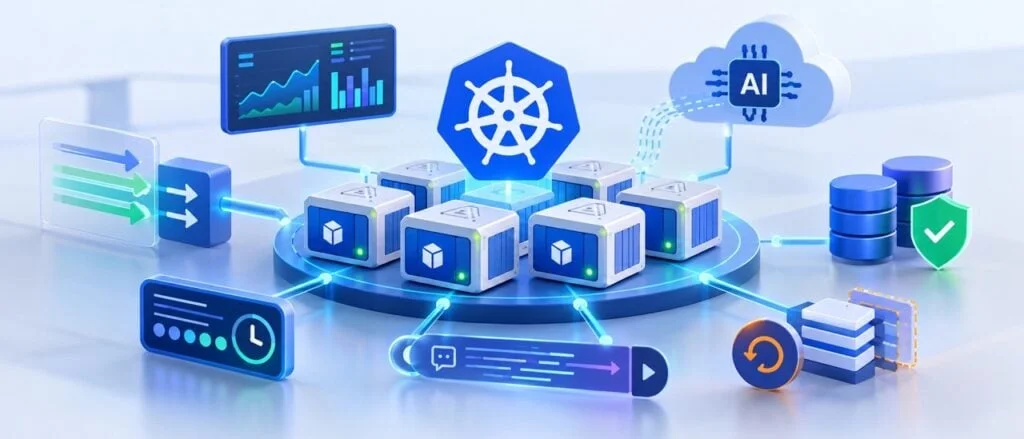
Kubernetes sets a solid foundation for deploying AI applications, but effective production requires additional safeguards to handle issues like slow startup, uneven demand, and dependency management.
The difference between a functioning prototype and a scalable production system is significant. While a model may work seamlessly for a single developer, it can face unpredictable performance when tasked with multiple requests or when the workload changes. Addressing this disparity demands a meticulous approach that fosters reliability and accountability.
Here’s a breakdown of six strategies that can enhance production readiness and effectively manage AI applications on Kubernetes.
1. User-Centric Health Definition
It’s critical to employ startup, readiness, and liveness probes thoughtfully. A startup probe should measure the time taken for essential components to initialize, while readiness checks confirm if a Pod can handle incoming requests. Liveness checks could detect a malfunctioning process requiring a restart.
It's wise to decouple liveness checks from the state of external model providers to avoid unnecessary restarts spurred by transient issues. Instead, focus on ensuring that any failed readiness checks signal the need for a Pod to step back from accepting new requests. Metrics are key here; expose dependency health to inform maintenance actions, and utilize circuit breakers for boundary protections.
2. Intelligent Scaling Beyond CPU
Traditional CPU monitoring can be misleading. For an AI service burdened with retrieval delays or dependency waits, relying solely on CPU usage can lead to miscalculations in scaling decisions. It’s prudent to adopt scaling metrics indicating outstanding work—like queue depth and active requests—while also measuring response times to identify bottlenecks.
Utilizing Kubernetes’ autoscaling capabilities and customizing metrics to reflect these realities can help maintain performance. Tracking concurrent requests and setting limits inline with available resources will avoid over-committing workloads that lead to subjective errors.
3. Implement Backpressure with Dependencies
Prioritize admission control before initiating resource-intensive tasks like model inference. Imposing limits on user calls, setting concurrency thresholds, and managing queue sizes are crucial to prevent overwhelming the system.
Each component involved in handling retries should coordinate to avoid compounding failures. An uncontained failure can rapidly escalate into a larger issue. By controlling retries through central management and introducing deliberate delays, systems can gracefully handle excess demand without resorting to chaos.
4. Approach Streaming Connections as Stateful
Streaming data, such as server-sent events or WebSocket sessions, requires special consideration beyond standard request handling. When transitioning between Pods, interruptions can occur unless a proper state management system is in place.
Maintain any ongoing sessions or conversational contexts outside of the Pods to provide continuity for clients. Define whether your application can safely reconnect to a session or must start anew. During normal Pod termination, ensure that new connections are halted, and traffic is gracefully drained to prevent data loss.
5. Secure Identity and Data Management
Safeguarding sensitive credentials and model keys is imperative. Avoid embedding these within Docker images or configuration files. Utilize short-lived or dynamic credentials, ensuring that access scopes are minimal and well-defined for each workload.
When managing sensitive information in Kubernetes, it’s vital to enable encryption at rest and apply least privilege principles to all data access. Consideration of how prompts and contexts are retrieved and processed is necessary to align with safety and compliance standards.
6. Observability and Reversibility for Model Changes
Monitoring the full request lifecycles, including retrieval paths and model deployments, should go beyond surface-level metrics. Track relevant data points such as inference times, model versions, and outcomes to identify trends in performance degradation.
It’s essential to maintain a known-good state and a fallback mechanism. When deploying updates, testing in canary releases, and establishing criteria for halting rollouts are key tactics to mitigate risks associated with new models or changes.
Production Readiness Equals Managing Failures
Before moving to production, ensure that the system's failure modes are well-tested. Model slowdowns, credential rotations, and service interruptions must all be understood clearly for fair operational behavior. Ensuring these components are monitored and managed empowers teams to utilize Kubernetes’ inherent capabilities fully, tailoring them for the complexities of AI applications.
Resources:
Discussion
Sign in to join the discussion.