Enhancing Kubernetes Resilience: A Deep Dive into Liveness and Readiness Probes Challenges
Sep 25, 2026 · 464 views
A missing command in Kubernetes liveness probes led to unnecessary restarts, highlighting the need for effective health checks in containerized environments.
A Technical Glitch in Kubernetes Liveness Probes
A recent oversight involving Kubernetes liveness probes has spotlighted a significant challenge that developers face when deploying applications in a containerized environment. Here's the kicker: a missing command-line utility—`pgrep`—in the slim Node.js runtime led to a situation where a healthy Redis worker was caught in a frustrating restart cycle. This issue underscores the complexities of managing dependencies in cloud-native applications, an area that requires deep understanding and careful planning.
Imagine this scenario: a Node.js background worker that's not serving user-facing traffic fails its liveness check. The original implementation relied on a basic exec probe that executed the command `pgrep -f server/worker`. However, the absence of `pgrep` in the minimalist Docker image meant that every liveness check resulted in a failure, prompting Kubernetes to keep restarting the worker unnecessarily. This situation is more than just an inconvenience; it exposes a general vulnerability in how systems can be configured without critical utilities. Constantly restarting ultimately pushed the container into a `CrashLoopBackOff` state, showcasing just how a seemingly trivial dependency can lead to broader instability that can ripple through application performance.
The real problem isn’t merely that the command was missing; it’s that the method itself was flawed. `pgrep` can identify whether a process exists, but it doesn't validate whether that process is functioning correctly or communicating with Redis as intended. This means that a process could be sitting idle, stuck in limbo, and still pass the liveness check. The implications here could extend to lost operations and failed service-level agreements, something an organization would be keen to avoid. Flaws like this reveal that liveness check mechanisms need to be holistically designed, factoring in not just process existence but also process vitality.
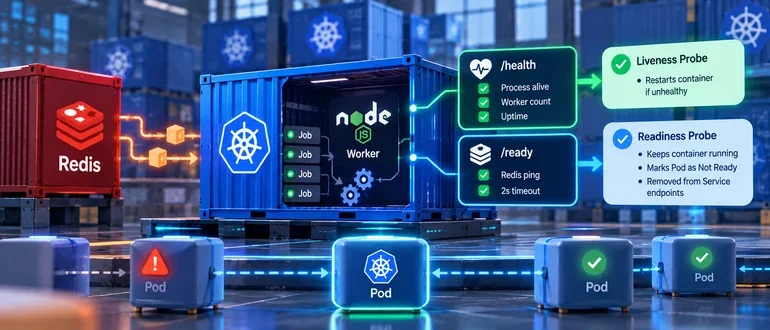
To address this, developers pivoted to implementing a more meaningful solution by introducing an in-process HTTP server that provided a `/health` endpoint. This endpoint became a litmus test for the ability of the Node.js event loop to respond to requests. By making this change, developers ensured that the health endpoint’s responsiveness was a reliable indicator of application availability. Importantly, though, this redesign avoids making any assertions about its connection to Redis. This careful distinction is pivotal in preventing redundant restarts during transitional Redis unavailability, which could snowball into larger operational issues, potentially affecting user experience and system reliability.
Readiness Probes: More Than Just Status Checks
It's also essential to examine the role of readiness probes in this context. These probes are integral to assessing whether an application is ready to handle requests. While the newly implemented readiness checks ping Redis with a specific timeout, they won't halt a worker that's continuously pulling jobs from the Redis queue. This can lead to peculiar states where Kubernetes declares a worker “not ready,” yet the system may still operate under a workload. In this case, if a worker is deemed not ready by the readiness probe, the application itself must manage job consumption directly.
This nuance is often overlooked and can lead to situations where Kubernetes struggles to align Pod statuses with actual application behavior. The result can be convoluted management scenarios where teams are forced to deal with inconsistencies between what Kubernetes reports and what application instances are actually doing. (And this is the part most people overlook.) The implications of the worker's readiness impacts how efficiently jobs are processed during critical business cycles.
The situation begs a broader question: how can organizations ensure that their Kubernetes deployments are resilient and responsive? The lessons from this incident advocate for implementing thorough checks. For instance, developers should not only execute command probes within the actual runtime images rather than a development shell, but they should also validate how failure scenarios, like a Redis outage, affect readiness without inadvertently inflating restart counts.
This brings to light a vital component of Kubernetes management: the agility of response in multi-service architectures. To put it plainly, if you're working in this space, taking a closer look at your readiness and liveness checks can yield a more stable application environment.
Implications for Future Developments
The worker's readiness and liveness checks have stirred a conversation about dependency management and the necessity of precise application behavior control in Kubernetes environments. As organizations strive for greater reliability, the importance of application-level controls can't be overstated. The discussions that arise from this incident serve as a reminder that building resilient systems in cloud-native deployments requires ongoing attention to detail.
Going forward, one implication is that development teams might increasingly prioritize testing in environments that reflect production more accurately. This approach can mitigate the risks posed by missing dependencies that aren’t apparent during early development cycles. There's an emerging need for improved tooling and practices that account for the intricacies of modern application requirements. Teams will likely enhance their observability frameworks to ensure that application health metrics represent not just surface-level checks but deeper operational states.
As we observe the evolving practices surrounding Kubernetes, the tension between functionality and complexity remains palpable. This is more significant than it looks; how organizations adapt to these challenges will determine their success in harnessing cloud-native technologies. Embracing a rigorous approach to dependency management and response checks could differentiate the reliable systems from those that falter when unforeseen complications arise. The future of Kubernetes application management may hinge on these critical insights.
Discussion
Sign in to join the discussion.