Musk says Grok 4.8 won't match Claude Opus 5.5 as xAI rewrites its stack in C/C++. Grok 5 is pitched to beat it, but no firm date exists.

In brief
- Musk says Grok 4.8 won't match Anthropic's Claude Opus 5.5, which he called a "masterpiece."
- Grok 4.8 has finished pretraining and could reach a limited rollout this week, following a rewrite of xAI's software stack.
- Musk says Grok 5 could beat Opus 5.5 in two or three months, but he offered no benchmark comparisons or firm release date.
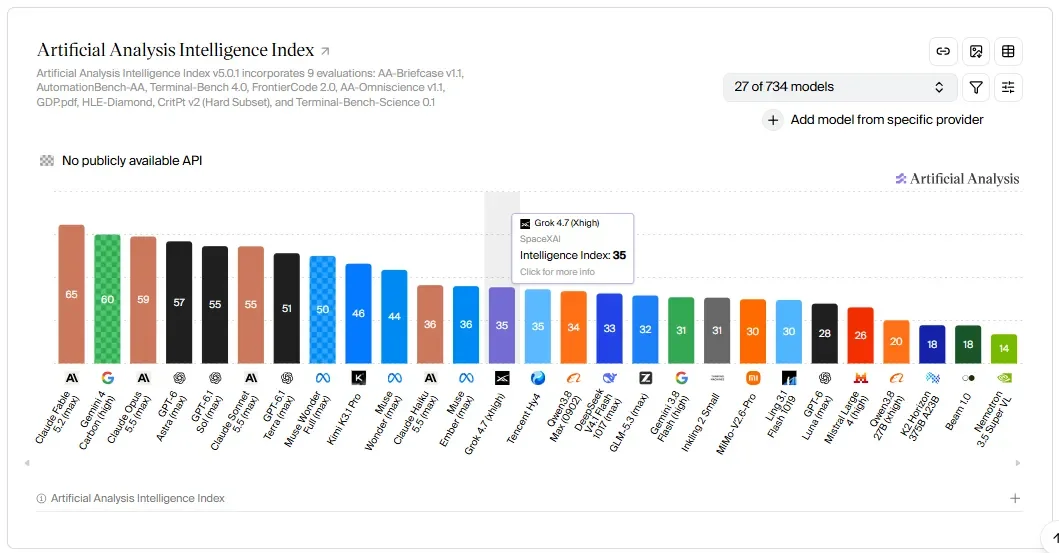
Elon Musk just paid a rival model a compliment most chief executives would hesitate to give, and in the same breath conceded that his own next release won't beat it. Asked how Grok 4.8 stacks up against Anthropic's Claude Opus 5.5, the xAI founder said it would be "not as good." Then he added: "Opus 5.5 is a masterpiece."
The reply came Tuesday, in response to a user named Dimdv. Musk went further, saying Grok 5, the next-generation model due after this update, "should exceed Opus 5.5," possibly within two or three months. He gave no detail behind that estimate and no firm date. Musk's track record on target dates is spotty, so treat that window as a hope rather than a plan.
Why Grok 4.8 is taking longer
Musk's explanation started with a technical update. Grok 4.8 has finished pretraining but is still in reinforcement learning (RL), the stage where feedback and rewards refine how a model responds. The team also spent considerable time cleaning up its supervised fine-tuning data, the examples that teach a model to follow instructions. It's unglamorous work, and it's often where the calendar goes. The bigger change sits lower in the stack. Musk said xAI dropped JAX, a machine-learning framework, and SGLang, the software used to serve models, in favor of an inference and reinforcement-learning system rewritten in C and C++. Inference is the step that happens after you send a prompt and the model generates its answer. Owning that code gives engineers more control over performance. Musk didn't share figures showing how much faster or cheaper things got, so the payoff is still a claim. Developer tetsuo celebrated the announcement with "C wins again." Musk pushed back on the framing, saying the code was "C with a little C++." He then credited Starlink engineers with work that helped build the Grok training and inference stack. He pointed to SpaceX's habit of writing its own headers and handling precise time calculations, including leap seconds. It's an unusual shout-out, and it shows how much Musk wants xAI's infrastructure to look like it was built by his engineering teams as a whole. Musk described Grok 4.8 as "not yet incredible," but said its foundations are finally built correctly. A soft rollout to Bot users is expected later this week, which gives the company an early test before any broader release.Anthropic's head start
For a company trying to close the gap with Anthropic and OpenAI, that admission matters. Grok 4.8 is the near-term release, and it may reach some users this week. Grok 5 is the model Musk hopes will eventually put xAI ahead, but it's a bet on something that doesn't exist yet. And the clock on that bet runs against rivals who may ship a new model first. Praising Opus 5.5 while promising to surpass it later is a telling position. Musk is conceding the current lead and wagering everything on the next release.The cost cut matters more than the benchmark
Anthropic released Opus 5.5 on September 22, and the claim that should catch your attention is that it performs close to Fable 5.1, the company's higher-end model, on most work. Matching a stronger sibling is nice. The more consequential number is the 40% drop in running cost on typical workloads compared with the previous Opus. If you're paying for agent loops that chain together many steps, that figure shows up on your invoice. Anthropic is pitching the model at two jobs: hard programming tasks, and agents that work through multistep problems with little human help. Those are exactly the workloads where cost compounds. An agent that makes dozens of model calls per task feels every efficiency gain, and so does the bill when the efficiency isn't there.Read the Terminal-Bench number carefully
Terminal-Bench 4.0 checks whether AI agents can finish complicated tasks in a command-line environment, scoring them by the share they complete. Anthropic reports 66.4% for Opus 5.5 against 57.9% for OpenAI's GPT-6 Astra. That's a gap of about 8.5 points on a single benchmark, and it's the vendor's own measurement. It's a meaningful signal, but I'd want independent runs before calling it a settled lead.
Discussion
Sign in to join the discussion.