Learn how to refine Kubernetes readiness probes to ensure application traffic only routes when true operational readiness is achieved.
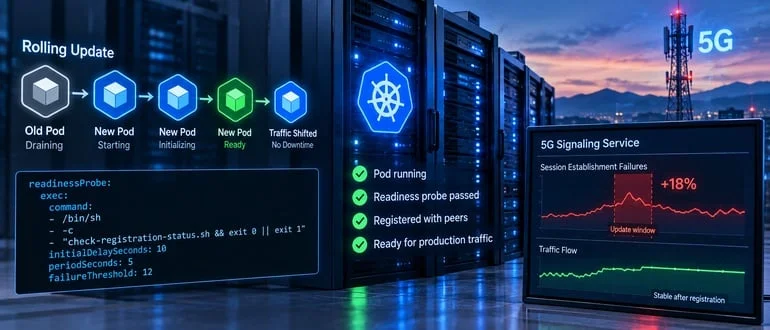
Rolling updates in Kubernetes are celebrated for their ability to minimize downtime during application deployments. However, the assumed efficacy of readiness probes can lead to significant traffic issues if they're not configured to accurately reflect true application readiness. When a readiness probe merely checks if a process is running rather than validating its operational state, you risk routing traffic to pods that aren’t truly prepared. This disconnect can be critical in environments involving complex protocols such as SIP or GTP.
Understanding Readiness Probes
At their core, Kubernetes readiness probes are designed to distinguish between a pod that has started successfully and one that’s truly ready to handle incoming requests. They achieve this primarily through HTTP checks, where a 200 OK response signals readiness. While this approach works well for stateless web services, where application health typically correlates with HTTP responsiveness, it quickly becomes inadequate for stateful applications.
The Challenge of Stateful Workloads
In environments like telecommunications, pods need to undergo various startup and registration procedures before they can service requests. Consider a scenario involving a 5G signaling application: a pod may pass its readiness probe immediately after startup, returning a successful HTTP status. Yet, if it's still in the registration phase with upstream services, it’s misleadingly marked as ready to handle production traffic. The result? Real operational metrics, like session establishment attempts, may degrade, revealing an 18% spike in failures during updates.
Why HTTP Probes Can Be Misleading
Standard HTTP probes check only the basic functionality of an endpoint, which can lead to false positives regarding readiness. For example, in our 5G case, the old pods were draining as the new pods came online. While Kubernetes marked the new pods as healthy, they were actually in the process of registering and establishing connections—factors undetected by a simple HTTP check. This misalignment leads to degraded service quality, as the applications aren’t yet part of the operational flow, impacting overall user experience.
Protocol-Aware Readiness Checks
To address these pitfalls, teams need to implement protocol-aware readiness checks, which involve more than just confirming operational status. These tailored checks should ensure that the application has completed necessary procedures such as peer registration, handshakes with associated services, or warm-up activities to establish a functioning state before it's marked ready. For instance, using a custom script that queries the internal state can give teams insight into whether a pod is genuinely prepared to handle requests.
Employing Exec Probes
By utilizing an executable probe instead of a simplistic HTTP probe, you can embed more intelligence into your checks. For example, an exec probe might invoke a shell script designed to validate the registration status of the pod within the signaling infrastructure. An example configuration would look like this:
readinessProbe:
  exec:
    command:
    - /bin/sh
    - -c
    - "check-registration-status.sh && exit 0 || exit 1"
  initialDelaySeconds: 10
  periodSeconds: 5
  failureThreshold: 12
This configuration ensures that a pod won’t receive traffic until it’s confirmed ready by evaluating not just process health, but its integration within the required operational framework.
Recognizing the Distinction
The critical takeaway is the difference between a pod that is merely running and one that’s truly ready. In stateless services, this distinction may seem trivial. However, in complex applications that require protocol engagement and stateful interactions, the gap becomes pronounced, often leading to unnoticed failures masquerading as operational success. Relying solely on HTTP responses assures you of nothing more than a process’s ability to answer a ping.
Enhancing Deployment Practices
For organizations utilizing Kubernetes, understanding the readiness state of your applications is paramount. Implementing protocol-aware readiness probes might seem like an added complexity, but it’s essential for achieving truly zero-downtime deployments. If your current setup routes traffic based on superficial health checks, it’s time to reevaluate. The goal isn’t just to pass Kubernetes’ checks but to ensure your applications handle user requests effectively from the moment they are deployed.
By accurately defining what it means for a pod to be "ready,” your team will be better equipped to prevent subtle service degradations that could affect end-user experiences during updates. Deploying applications effectively means moving beyond what’s easy to check and focusing on what guarantees reliable service delivery.
Discussion
Sign in to join the discussion.