Explore how AI agents are reshaping industries by automating processes, enhancing efficiency, and improving decision-making across various sectors.
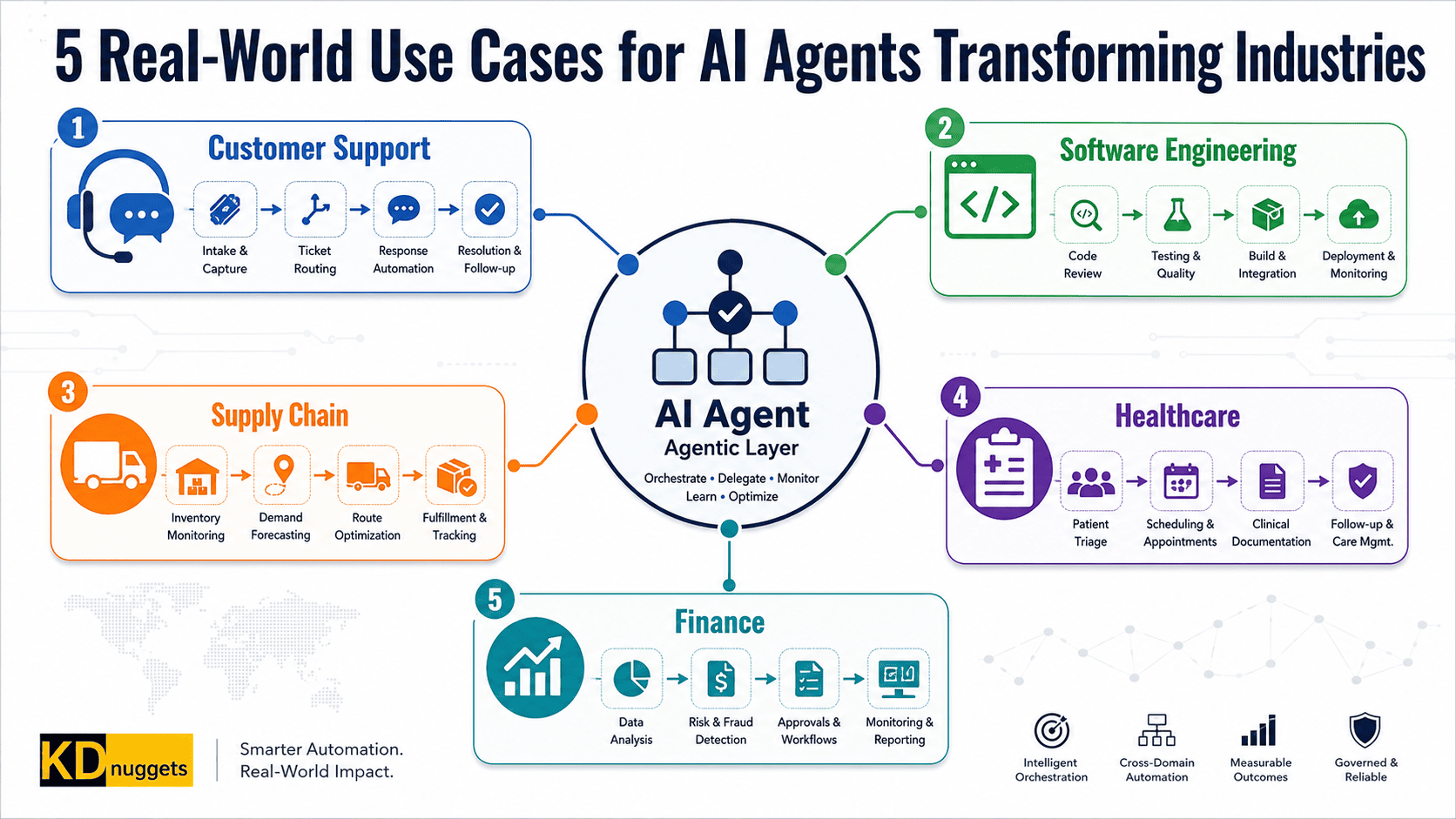
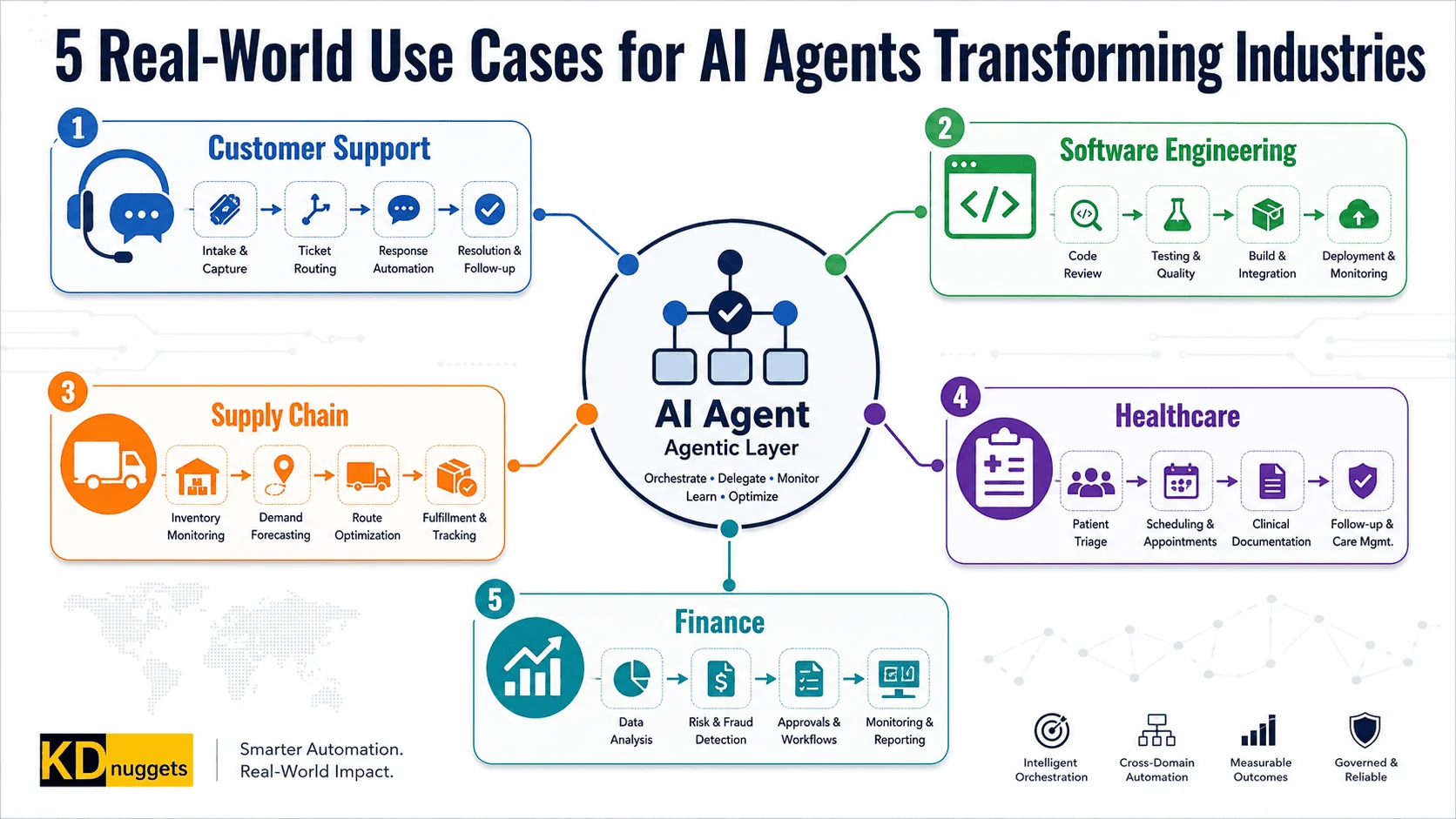
AI agents have transitioned from theoretical concepts to powerful tools that enterprises actively implement. As of 2026, these autonomous systems can carry out complex workflows independently, evolving beyond the functions of traditional chatbots that merely respond to user prompts. Here’s a closer look at five impactful applications where AI agents are transforming critical sectors.
1. Automating End-to-End Customer Support
Today's consumers demand swift and efficient support across various platforms, placing pressure on customer service departments to deliver beyond what conventional chatbots can offer. AI agents now integrate directly with customer relationship management (CRM) systems, allowing them to autonomously resolve multi-step customer queries, from managing refunds to updating orders.
- Autonomous Execution: These agents can draft responses, check stock levels, process returns, and update the CRM ticket without human intervention.
- Intelligent Routing: When complex issues arise, agents can elevate the ticket to human staff with a detailed summary, preserving contextual information.
- Proactive Engagement: Agents are designed to anticipate issues, enabling them to take corrective actions—like rebooking flights—before customers even realize there’s a problem.
This shift not only minimizes average handling time but also allows human agents to shift their focus toward more nuanced customer interactions.
Learning Resource: Discover how to build customer support agents through the LangChain documentation, which connects language models with essential CRM tools.
2. Enhancing Software Development and Testing
The landscape of software engineering is evolving with the introduction of autonomous coding agents. No longer confined to simple code suggestions, these agents can manage substantial operations—from analyzing GitHub issues to writing full features, testing them, and submitting pull requests—all without any developer intervention.
- Contextual Code Understanding: Utilizing the Model Context Protocol (MCP), agents comprehend entire code repositories, enabling them to draft code that aligns with existing standards and practices.
- Automated Quality Assurance: They autonomously generate and run test suites, debug issues, and iterate until the code meets predefined benchmarks.
- Legacy System Modernization: Businesses are now using agents to transition older programming languages like COBOL to modern frameworks, streamlining processes that would historically require extensive developer input.
As a result, developers can dedicate more time to architectural work and systematic review rather than mundane coding tasks.
Learning Resource: Check out the SWE-agent open-source project to see how agents resolve real issues in software engineering.
3. Optimizing Supply Chain Management
Global supply chains face significant challenges from unpredictable disruptions, prompting logistics companies to implement multi-agent systems. These AI agents monitor real-time data feeds to autonomously manage reroutes at the first sign of a disruption, expediting what used to be a lengthy human process.
- Immediate Re-routing: AI agents dynamically recognize congestion or delays and autonomously select alternative routes, adjusting delivery schedules accordingly.
- Smart Inventory Management: By continuously analyzing demand, agents can place orders automatically, significantly reducing the risk of stock shortages.
- Efficient Invoice Reconciliation: AI agents streamline the matching process of invoices with purchase orders, alerting humans only to significant discrepancies, thus reducing manual workload.
Learning Resource: To grasp the principles of multi-agent reinforcement learning (MARL), visit the Berkeley AI Research lab and explore their insights on optimizing logistics.
4. Revolutionizing Healthcare Workflows
Healthcare providers are increasingly overwhelmed by administrative tasks that detract from patient care. AI agents are now being employed to handle everything from patient data management to scheduling, effectively alleviating clinician burden.
- Ambient Documentation: These agents observe consultations, creating structured clinical notes and uploading them to Electronic Health Records (EHRs), thus eliminating post-visit paperwork.
- Streamlined Insurance Processes: By automating the analysis of treatment plans against payer guidelines, agents can significantly reduce the time needed for pre-authorization submissions.
- Patient Monitoring Post-Discharge: Agents can autonomously check in with patients regarding their recovery, alerting nurses to potential complications much sooner than standard follow-up schedules.
Learning Resource: Explore the Kore.ai framework for healthcare agents that manage HIPAA-compliant workflows.
5. Strengthening Financial Compliance and Fraud Detection
In finance, the battle against fraud requires constant vigilance. Traditional systems are plagued by false positives, making it hard to identify genuine threats. AI agents are stepping in by conducting thorough investigations of potential fraud swiftly and accurately.
- In-Depth KYC Investigations: Agents can autonomously gather extensive data from public records and other sources to build detailed risk profiles of clients.
- Contextual Analysis of Transactions: Upon flagging transactions, agents assess user behavior and context to make informed decisions about potential fraud.
- Automated Reporting: When fraud is detected, agents swiftly generate compliance reports, simplifying the regulatory process for human analysts.
Learning Resource: Delve into DeepLearning.AI courses that focus on AI applications in finance.
Looking Ahead
The shift from simple generative AI to sophisticated agentic systems marks a significant evolution in how technology is applied across various industries. From customer service to healthcare and finance, AI agents are not just assisting workers—they're redefining workflows by taking on repetitive, time-sensitive tasks while humans focus on strategic roles. As these systems continue to expand, the potential applications only seem to grow.
Discussion
Sign in to join the discussion.