Explore three defined career paths in AI—Builder, Innovator, and Translator—to align your skills and interests with the right opportunities.
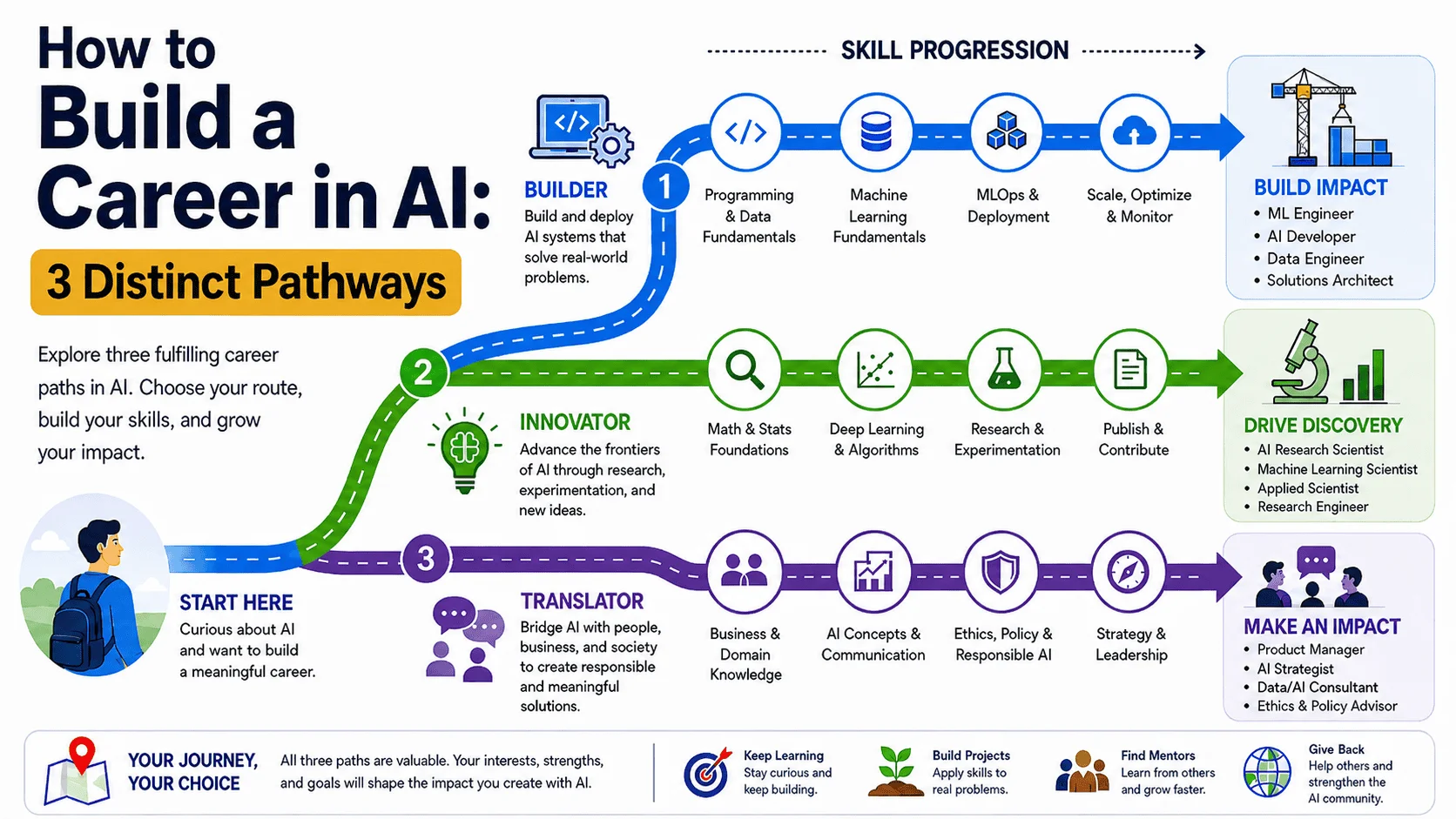
Mapping Your Career in Artificial Intelligence
Countless aspiring professionals enter the field of artificial intelligence (AI) each year, yet many struggle to find their footing. A prevalent inquiry I encounter during mentorship sessions is, "How do I break into AI?" While enthusiasm runs high, a lack of clarity about the various career paths often leaves students feeling lost. It's essential to grasp that roles within AI—ranging from machine learning engineers to data scientists—are not interchangeable; each demands a unique skill set and focus.
Defining the Landscape of AI Careers
The term "career in AI" can be misleading due to the diverse nature of roles it encompasses. For instance, one company's AI Engineer may adapt large language models (LLMs), while another's might focus on integrating APIs within products. This ambiguity leads many to optimize for an unattainable average role, ultimately causing frustration. To avoid this pitfall, candidates should first pinpoint their strengths and areas of interest before diving headfirst into learning.
Pathway 1: The Builder (Engineering and Deployment)
The Builder pathway is tailored for those who enjoy constructing and deploying systems that work reliably at scale. This role emphasizes software engineering over theoretical knowledge, focusing on practical skills such as writing efficient code, managing data pipelines, and maintaining system stability. If seeing tangible outcomes from your work excites you, this might be the right avenue.
Common roles within this pathway include:
- Machine Learning Engineer: Specializes in transitioning predictive models into production-ready applications.
- Data Engineer: Constructs the data pipelines necessary for preparing data for modeling.
- AI Developer: Integrates external AI services into applications, enhancing user functionality.
Interestingly, many prospective Builders misinterpret this path as requiring deep algorithmic knowledge. In reality, it often demands solid software engineering skills. For example, I once mentored a talented student who excelled in modeling accuracy but lacked essential skills in versioning models and monitoring performance. Interviews for these roles typically emphasize engineering competencies just as much as modeling ability. Therefore, aspiring Builders should focus on mastering languages like Python, and tools such as scikit-learn and PyTorch, alongside familiarity with cloud platforms.
Pathway 2: The Innovator (Research and Science)
In contrast to Builders, Innovators are positioned at the cutting edge of AI. They seek to advance existing systems and explore new methodologies. This pathway is markedly more challenging, involving rigorous mathematical understanding, including linear algebra, probability theory, and optimization techniques.
Typical roles here include:
- Research Scientist: Develops new AI learning techniques, generally necessitating a Ph.D.
- Data Scientist: Analyzes vast datasets to extract insights and builds foundational models that Engineers deploy.
- Deep Learning Specialist: Focuses on neural network structures, particularly in natural language processing or computer vision.
A common misconception is that passion for research is sufficient for entry into this field. I have encountered many students who were drawn to research due to its intellectually stimulating nature but lacked foundational knowledge in necessary mathematical disciplines. Gaining comfort with abstract concepts and committing to further academic pursuits is necessary to thrive in this pathway. Prospective Innovators can assess their readiness by engaging with courses such as the DeepLearning.AI Machine Learning Specialization or fast.ai.
Pathway 3: The Translator (Product, Strategy, and Ethics)
Often overlooked, the Translator pathway is where many individuals find their best fit. Translators serve as the bridge between technology's capabilities and an organization's goals—understanding both the potential and limitations of AI. While not typically involved in coding, they need a solid grasp of AI fundamentals to strategize effectively.
Roles typical of this path include:
- AI Product Manager: Responsible for defining product vision and aligning it with user needs and technical constraints.
- AI Governance or Ethics Lead: Ensures that AI implementations adhere to ethical guidelines and compliance standards.
- Prompt Engineer: Works on formulating inputs for LLMs to ensure accurate and safe outcomes.
A misconception exists that this path is a less desirable option compared to technical roles. In fact, the ability to discern applicable AI solutions and articulate them effectively often positions Translators as key assets within organizations. For instance, I advised a nurse seeking to transition into machine learning; her clinical expertise provided her with a perspective that many technical candidates lack, giving her a unique edge.
If this direction resonates with you, engaging with resources like the Hugging Face LLM Course can help build the necessary skills to communicate effectively around AI technologies.
Selecting the Right Path for Your Career
A recurrent mistake I observe is individuals selecting a pathway based on perceived prestige rather than a genuine alignment with their skills and preferences. The accelerated growth of AI can often obscure a realistic overview of job requirements, leading many to formulate plans without thoughtful consideration of their starting point.
Before making any commitments, consider these steps:
- Identify your core strengths: Are they in engineering, mathematics, or a specialized domain?
- Review job postings for the various paths to compare day-to-day responsibilities.
- Engage with professionals currently in those roles to gain insights beyond superficial descriptions.
- Assess your available preparation time realistically for paths requiring long-term investment.
- Choose one focus area and construct a coherent skill development plan instead of dabbling across multiple options.
- After six months of concentrated effort, reevaluate your choice rather than rushing the process.
The following table summarizes the distinctions between these pathways:
| Pathway | Ideal for | Typical Background | Skills Emphasized |
|---|---|---|---|
| The Builder | Enjoy constructing systems and seeing direct results | Computer Science or Software Engineering | Python, PyTorch, cloud technologies |
| The Innovator | Embrace mathematical challenges and open questions | Advanced studies in Math or Computer Science | Linear Algebra, Statistics, Optimization |
| The Translator | Skilled in communication and strategic thinking | Education in Business, Law, Design, or specific domains | Product Development, User Experience, Domain Knowledge |
Navigating Your Path Ahead
Throughout my mentorship experiences, I've consistently observed that success across these three paths stems from recognizing their distinctiveness rather than seeing them as interchangeable options. Each pathway values different strengths and requires divergent preparations. When you're clear about which orientation matches you, the journey toward building your skills becomes more straightforward. The focus shifts from seeking a generic ideal to pursuing a personalized trajectory that's aligned with your skills and aspirations. Whether you’re crafting algorithms, advancing methodologies, or utilizing AI effectively, your choice has implications for your future success. Commit to one path and hone your expertise to achieve fulfilling outcomes in the realm of AI.
Discussion
Sign in to join the discussion.