Bitcoin’s muted reaction to Binance’s record hack may reflect a larger market and institutional ETF holders, but their response is still unclear.

A record hack, and a market that barely flinched
The striking part of Binance’s record $6.4 billion hack may be the market’s muted response. Bitcoin fell to about $76,400 on Friday, roughly 6% below its level after Wednesday’s Federal Reserve decision. More than $1.3 billion in leveraged positions were liquidated as exchanges automatically closed trades funded with borrowed money. Yet Bitcoin’s decline was relatively contained. That reaction looks different from March 2018, when an attack on Binance sent Bitcoin from $10,740 to $9,690 in minutes. The exchange said no funds were stolen then. This time, Binance has confirmed a theft that Chainalysis and TRM Labs estimate at roughly $6.4 billion—more than four times the previous record, the $1.5 billion Bybit heist in February 2025.
A larger market, and different holders
Crypto’s market value has grown from just over $400 billion in March 2018 to roughly $2.6 trillion. That change matters when comparing the two selloffs: the same shock lands in a much larger market, with a different mix of buyers. U.S. spot Bitcoin ETFs are a major part of that shift. Funds such as BlackRock’s iShares Bitcoin Trust let investors buy Bitcoin through a regular brokerage account. Together, these funds hold roughly 1.3 million BTC, about 6% of the supply. Their shareholders don’t keep those coins on Binance, and sovereign wealth funds—including Mubadala and the Abu Dhabi Investment Council—have been buying. BlackRock’s fund alone took in $136 million on Wednesday, according to Farside Investors data. That institutional presence may help explain why panic hasn’t spread as quickly. ETF investors may be less inclined to sell in a rush, and their holdings can stay invested for long stretches. But it’s too early to know whether they’ll hold through this breach: the attack began at 4:05 p.m. ET on Thursday, after U.S. markets closed. Thursday’s preliminary $17 million in ETF inflows came before the theft. Friday’s figures are the first useful indication of whether those investors are pulling back.The money trail is still unfolding
The attacker still holds more than 420,000 ETH and 18,270 BTC, worth about $2.4 billion—assets no stablecoin issuer can freeze. That estimate excludes other tokens, which would bring the total above $3 billion. Binance says it has set aside more than $6.34 billion to cover losses, about $3 billion has been frozen, and withdrawals should resume in 45 hours. TRM Labs and Chainalysis link the attack to the North Korean group behind the Bybit heist. After that theft, the group [converted about 84% of the stolen Ethereum into Bitcoin](https://decrypt.co/315593/bybit-ceo-two-thirds-of-funds-from-lazarus-group-hack-still-traceable) using Thorchain, a network for swapping assets across blockchains. The firms’ attribution and the attacker’s current balances offer clues about what may happen next, but neither tells us how much of the stolen money can ultimately be recovered. For context, here’s [how analysts tied the $6.4 billion Binance hack to North Korea’s TraderTraitor group](https://decrypt.co/382224/trm-and-chainalysis-tie-6-4b-binance-hack-to-north-koreas-tradertraitor), and [why the episode overshadowed Hyperliquid’s biggest day](https://decrypt.co/382225/morning-minute-binances-6-4b-hack-overshadows-hyperliquids-biggest-day). BlackRock’s Wednesday inflows came amid a broader shift in ETF buyers, including [sovereign wealth funds stepping in](https://decrypt.co/382135/morning-minute-hedge-funds-left-the-btc-etf-trade-and-sovereign-wealth-stepped-in).Binance can cover the losses. The market still has to find buyers.
Binance says it has earmarked more than $6.34 billion in company funds to cover losses, and is replacing missing tokens through both exchange trading and private over-the-counter deals. About $3 billion remains frozen. Deposits are working normally, while withdrawals are expected to resume in 45 hours. Those steps may contain the damage for customers, but they don’t erase the market’s underlying weakness. Sentiment had already been deteriorating before the theft. CoinMarketCap’s Fear and Greed index fell to 36 from 43, shifting from “neutral” into “fear.” Bitcoin, meanwhile, remains about 38% below its record high of $126,080. During the 2018 incident, the index stood at 12, deep in “extreme fear.” The current reading is less severe, but the hack landed in a market that was already under pressure.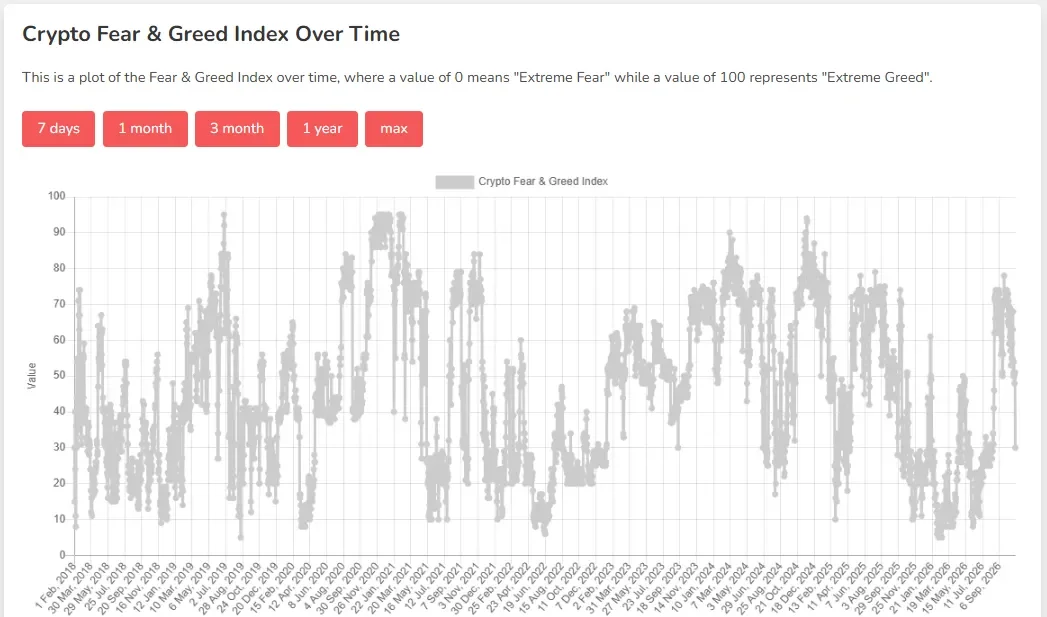
Discussion
Sign in to join the discussion.