Mirantis will assess and migrate VMware workloads to its MOSK platform, with typical projects taking about five weeks and aiming to reuse existing infrastructure.
Migration support built around MOSK
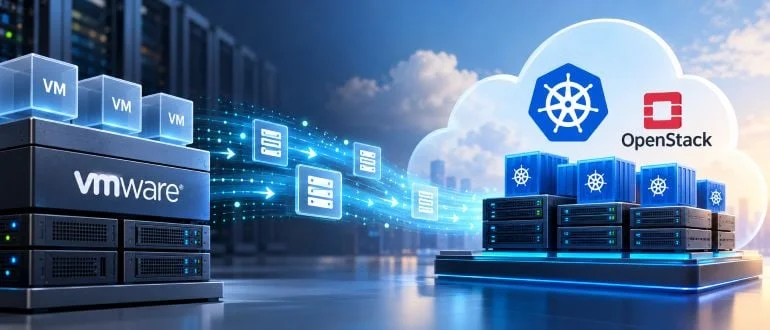
For organizations weighing a move away from VMware, the main hurdle may be operational expertise as much as technology. Migrating workloads means more than copying virtual machines: teams have to understand dependencies, plan how applications will run in a new environment, and keep the work manageable alongside day-to-day operations. Mirantis is addressing that gap with a service that pairs migration tools with staff support to move VMware workloads onto Mirantis OpenStack for Kubernetes (MOSK).
Mirantis product manager Cristian Klein said the company previously offered tools for these migrations. The new service adds Mirantis personnel to manage the work, starting with a free assessment of an organization’s environment. That assessment gives both sides a chance to examine what a move would involve before committing to the execution phase. Its value will depend on how clearly it identifies the workload and infrastructure constraints that could affect a project.
The destination is Kubernetes running on the OpenStack cloud framework. Mirantis says it aims to move workloads without requiring customers to add infrastructure. That claim could matter to organizations trying to change platforms without first funding a larger hardware footprint, but it doesn’t settle questions about capacity, application compatibility, or how the resulting environment will be operated. A migration plan still has to account for the systems around each workload, not just the virtual machines themselves.
Projects take about five weeks on average, Klein said, though the amount of data involved affects the timeline. That average is useful as an initial planning reference, not a promise for every environment. Data volume is one variable; the work can also depend on how much investigation and coordination a particular organization needs. Here's the thing: a short migration window only helps if the destination is ready to support the application once the move is complete.
The migration toolkit also addresses a dependency that has shaped other VMware exit plans. Mirantis has hardened open source software with capabilities similar to VMware’s Virtual Disk Development Kit (VDDK), which Broadcom no longer makes available. Competing migration providers had relied on VDDK. Replacing that dependency gives Mirantis a path that doesn’t require the unavailable kit, though the source doesn’t establish how the alternative performs across different workloads or migration conditions.
Licensing shifts meet skills constraints
Broadcom is promoting VMware Cloud Foundation (VCF) 9, which brings hypervisors, virtual storage and networking services into a more integrated platform. Some organizations may choose VCF 9, while others are considering full migrations or limiting new VCF workloads—for example, by placing new applications elsewhere. Those choices reflect different levels of commitment: a company can retain existing VMware systems while changing where future applications run, or it can plan a broader transition. The scale of any shift away from VMware remains unclear.
That uncertainty matters because a licensing change can prompt a review without making a migration practical for every application. Organizations have to weigh the cost and operational work of staying against the effort of moving. A decision to place new applications elsewhere may reduce future reliance on VMware, but it doesn’t by itself remove the older systems that remain in production. The work can stretch over time, with teams managing more than one platform as they make choices workload by workload.
For teams considering a move, older VCF environments and monolithic applications add complexity. Organizations must decide whether to keep those applications on virtual machines or rewrite them for cloud-native operation. Rewriting can change how an application is built and operated, so it’s a separate engineering decision from transferring its existing virtual machine. Klein observed that most still use a hypervisor to isolate workloads. That suggests a move to Kubernetes doesn’t automatically mean abandoning familiar isolation models or redesigning every application at once.
That decision also depends on staffing. VMware administrators may not yet have the experience to deploy and operate Kubernetes clusters at scale. Migration services can supply some of that expertise, Klein’s point, but outside help doesn’t remove the need for internal teams to understand and run the resulting environment. The handoff matters: a successful transfer of workloads is only one part of a platform change, and ongoing operations will still require people who know how the cluster and applications fit together.
Meanwhile, AI tools are lowering the engineering skills required to deploy Kubernetes, though the source gives no measure of how quickly or broadly. That could make some tasks more accessible, but it doesn’t show that staffing challenges have disappeared. If you're working in this space, the practical question is which parts of deployment these tools can help with and which operational responsibilities still require experienced staff. A lower barrier to getting started isn’t the same as having a team ready to run a production platform.
More platforms, similar team sizes
The pressure extends beyond moving existing applications. More teams are expected to run Kubernetes clusters as Broadcom’s licensing changes prompt platform reviews, and those clusters may host legacy software as well as newer AI workloads. That adds management demands across a more varied infrastructure, even when IT teams aren’t growing. Each additional platform can bring its own operating practices and skills needs, making the effect of a migration larger than the project that moves the first set of workloads.
This is more significant than it looks. A platform decision can redistribute work across an organization: application teams may have to adapt deployment practices, while infrastructure teams take responsibility for a different operating environment. The article’s central tension is that licensing changes can encourage platform reviews at the same time that Kubernetes adoption requires skills many VMware teams may still be building. A migration service can help bridge that gap during a project, but organizations will need to consider how they’ll sustain the new environment afterward.
Mirantis is positioning its service as a way to test a migration path and handle the execution burden. For technology leaders, the practical question is whether a target workload can move to MOSK on existing infrastructure—and whether the five-week average holds for their data and operating requirements. The free assessment may help make those questions more concrete, but its usefulness will depend on the detail it provides about workload fit, dependencies, and the work required after migration.
And yet, the broader decision isn’t simply whether VMware workloads can be moved. It’s whether the destination fits the organization’s applications, infrastructure, and staffing plans. That’s where the service’s promise will be tested. A workable migration path, with a realistic account of operational needs. (And this is the part most people overlook.)
Discussion
Sign in to join the discussion.