A 34-cluster Argo CD fleet shows how clear cluster contracts, rendered diffs and cautious deletion settings can keep GitOps manageable at scale.
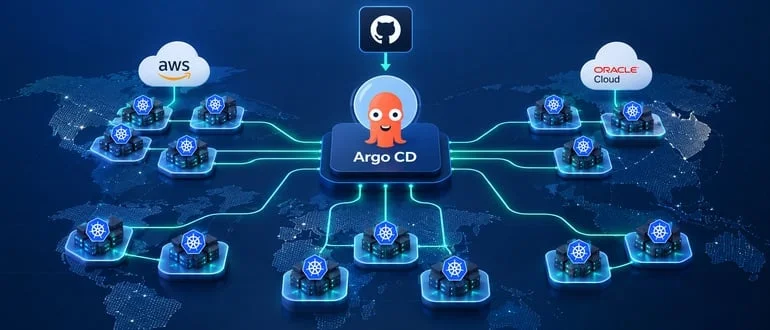
At 34 Kubernetes clusters, the hardest part of GitOps isn’t getting a controller to reconcile desired state. It’s making sure one change can’t surprise the whole fleet. A control plane built at Lucid Motors offers a practical view of that challenge: one Argo CD instance managed clusters across multiple cloud accounts, regions and continents, while the team used a small set of conventions to contain operational risk.
The system covered 34 clusters across 22 Amazon Web Services accounts and one Oracle Cloud tenancy, spanning five regions on three continents. A repository with 174 Helm charts rendered 1,214 Argo CD Application objects. Those numbers shift the engineering problem. A template or values change that works for one cluster may fail across dozens; a privileged central controller also gives a compromised change broad reach.
The timing underscored another constraint. On Oct. 6, 2026, Red Hat published a walkthrough of Argo CD ApplicationSets provisioning hosted control planes from Git. The next day, GitHub reported an outage affecting Actions, Git operations and pull requests, following smaller incidents on Oct. 5 and 6. GitOps can now manage the infrastructure that hosts applications, but the workflow still depends on services such as Git being available.
One controller, clear boundaries
The central hub ran the sole Argo CD instance for platform components. It kept cluster registrations, the identity used by the Cluster API controller, and three ApplicationSets. One set deployed a per-cluster baseline through an app-of-apps chart. Another placed shared platform services on the clusters meant to host them. The third managed Cluster API definitions for the clusters themselves.
That central view did not mean the hub owned every decision. Each spoke cluster controlled whether to accept the hub’s role through its own authentication configuration. It also owned the role Cluster API used inside that cluster, while workloads obtained cloud roles through the spoke’s identity provider.
On AWS, this arrangement avoided long-lived cross-account secrets in the hub. The hub received short-lived credentials, and each permission grant was declared on the spoke side and reviewed in Git. Oracle Cloud exposed a gap: registration still read a stored credential from a vault because the same arrangement wasn’t available there. That exception matters. A multi-cloud design should make its provider-specific limits visible, since a security property that holds in one environment may not carry over to another.
A small cluster contract keeps the fleet legible
The configuration model revolved around a cluster file containing about 20 keys. Those fields described identity, account boundary, region, environment, API access, delegated DNS and certificates, plus any opt-outs. The system derived the rest from that contract: Applications assigned to the cluster, IAM role names, Cluster API identity, DNS delegation and cost tags.
That choice reduced the number of places operators had to update when the fleet changed. Adding a cluster to a fleet meant changing a label on its registration. Adding a component meant adding one line to a list. Matrix generators handled the resulting distribution.
The model was also tested across a real organizational boundary. A Middle East expansion brought an Oracle Cloud tenancy into the fleet. It joined through the existing contract rather than through a custom setup. That’s a useful measure of whether a configuration model is doing its job: a new environment can fit without creating a parallel operating process.
Render the whole graph before merging
With 174 charts, the risk was a values change that rendered successfully in one context but produced broken output elsewhere. The team addressed that risk through merge-request checks that rendered the configuration across the fleet.
CI rendered each chart independently, each app-of-apps chart against every cluster contract, and every cluster definition. It also rendered each chart referenced by an Application with the exact values that Application would receive. The point was to validate the relationships among templates, values and cluster definitions—not just confirm that an individual file looked valid.
CI then rendered the target branch and posted the resulting manifest diff to the merge request. Reviewers could inspect the Kubernetes resources that would change on clusters instead of trying to infer the effect from Helm template edits. At this scale, the diff is an operational review surface: it helps expose changes that might be syntactically correct yet wrong for part of the fleet.
Drift metrics need comparable inputs
Reported out-of-band drift incidents fell from 24.3 a month before cutover to 0.9 afterward, across two 90-day windows. Those figures need careful reading. The earlier count came from incident tickets tagged as drift, and the tagging was incomplete. The later count came from controller diff events confirmed to have an out-of-band cause. The collection methods differ, so the comparison does not establish a precise 96% reduction.
It does show why instrumentation matters. Once drift could be identified through controller events, it appeared infrequently, and the controller corrected every confirmed case within its reconciliation interval without manual intervention. For teams tracking a rollout, using the same definition and collection method before and after would make the trend easier to interpret.
Make deletion behavior match the blast radius
A bad commit was the failure mode the team most wanted to contain. ApplicationSets were configured to preserve deployed resources when their definitions were deleted, preventing the removal of an entry from cascading into resource deletion. Cluster objects carried a no-prune setting, so a reverted commit couldn’t delete a running cluster.
These safeguards reflect a basic operational judgment: the controller’s actions should account for both the potential impact and the difficulty of reversing it. A cluster is a larger and slower-to-replace object than an ordinary application resource, so deletion defaults deserve particular scrutiny.
The same design thinking applies when Git or the hub is unavailable. Workloads run in the spoke clusters, so existing workloads can continue operating while GitOps deployments and configuration changes pause. The control-plane outage should not automatically become an application outage. The hub also deserves treatment as a highly privileged system: once a repository or CI change is merged, it can inherit the hub’s reach.
Onboarding gets faster when the path is repeatable
To bring a new cluster under management, the team created IAM roles in Terraform according to a naming pattern, wrote the cluster’s values file, opened a merge request for CI to render the full graph and post its diff, then merged the change and labeled the registration. Older, manually built clusters could be adopted in place through an explicit import path.
Average onboarding time was reported as 4.0 days across eight earlier clusters and 1.7 hours across 11 clusters after cutover. The first figure was reconstructed from change tickets; the second measured time from merge to the first successful sync. The cutover also removed manual approval steps, and the periods and samples differed, so the results aren’t a controlled comparison. They still point to a practical payoff from turning cluster setup into a repeatable workflow.
At this size, familiar shortcuts become fleet-wide risks: credentials held centrally, charts that no one renders against all their inputs, or deletion behavior left at defaults. The operating model that held up here combined a compact cluster contract with full rendering, visible manifest diffs and safeguards around destructive actions. For a team extending GitOps from applications to clusters, those controls are a useful starting point—and the provider-specific exceptions should be written down before the fleet grows further.
Discussion
Sign in to join the discussion.