Containerization enhances the security of AI coding agents by restricting access and minimizing vulnerabilities, fostering safer and more efficient workflows.
### The Significance of Containerization for AI Coding Agents
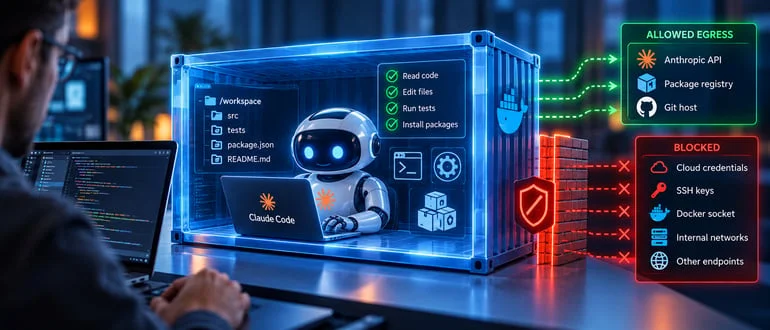
When it comes to deploying AI coding agents like Claude Code, containerization offers a compelling approach to mitigate security risks. As these tools extend beyond mere code completion and start executing complex tasks—like running scripts and modifying files—the potential vulnerabilities become a growing concern. It’s astonishing that most teams rely on repetitive permission prompts to control access. After dozens of approvals, those prompts become more of an annoyance than a safeguard. This is a missed opportunity to implement a more effective, structured control mechanism.
### Boundaries in Execution
Containers establish clear boundaries around what an AI agent can access, effectively curtailing the possible damage from unintended instructions or malevolent code. By restricting the environment in which these agents operate—through limited mounts, non-root execution, and controlled network access—you can significantly lower the risk associated with their deployment. Imagine not having to approve every single action the agent takes. Instead, you set the parameters once, creating a much easier and safer workflow for your team.
### The Shortcomings of Sandboxing
However, it’s crucial to understand that sandboxing is not a magic solution. While it effectively isolates the agent's access to only what's necessary, vulnerabilities still lurk. Shared workspaces and potential weaknesses in the host's kernel architecture can expose sensitive information. Controlling where the agent can network and tightening security measures around shared directories are essential. Navigating this landscape demands rigorous oversight and continuous evaluation.
### Identifying Required Resources
Think about what an AI coding agent truly needs to function: the project's source files, specific toolchains, and access to a package registry. It's a surprisingly short list. Yet, developers often give these agents access to far more—like credentials in `~/.aws` or `~/.kube`, VPN connections, and even Docker sockets. That disconnect can lead to serious security concerns if the agent misinterprets commands or runs a hazardous script. Containerization is a method to narrow that gap, ensuring the agent only interacts with what is strictly necessary.
### Implementing Safe Practices
To effectively containerize the agent, several key considerations must guide your process.
1. **Image Creation**: Start by building a minimal image that includes just your required toolchain, without self-updating capabilities. This ensures consistency across your team and development pipelines.
2. **Non-Root Execution**: Always run the agent as a non-root user. Claude Code functions optimally in environments that prioritize security; maintaining this practice is vital.
3. **Volume Mapping**: Limit mounts to project directories only. Keep sensitive configurations and states within named volumes, removing unnecessary bind mounts, especially those exposing SSH keys or Docker sockets.
4. **Scoped Credentials**: Use environment variables to pass short-lived tokens rather than long-term credentials. This minimizes the risk should something go wrong.
5. **Outbound Control**: Deny outbound traffic by default, only allowing access to necessary endpoints. Whether using an iptables script or an internal Docker network, ensuring that only specified connections can be made is paramount.
This methodology aims to cultivate a highly controlled environment, which balances accessibility with prudent security practices.
### The Advantages and Realities of Containerization
Implementing these strategies offers substantial benefits. First, damage is contained within the project directory. Should the agent perform an undesirable action, your resources remain protected. Additionally, permission prompts can be relaxed, allowing the agent to undertake tasks uninterrupted within a trusted environment. Finally, a unified image across your team also enhances consistency and eases onboarding for new engineers.
However, don’t overlook the limitations inherent in container setups. They create boundaries, but these boundaries are not impenetrable. The shared kernel and access points mean threats can still emerge, especially if proper protocols aren’t maintained. Additionally, collaborative policies stored within the repository can be altered by anyone with write access. This underscores the need for robust external policies that govern overall security.
### Conclusion: A Call for Discipline
In conclusion, while containers play a vital role in securing AI coding agents, they should be seen as a component of a broader security strategy. Establishing explicit boundaries and controlling what the agent has access to can reinforce the safety that traditional permission systems struggle to provide. As you rethink how these agents function, remember: clarity in what they need is essential to ensure they operate within safe confines.
Discussion
Sign in to join the discussion.