Enhancing Privacy in AI Transactions with Ethereum's zkAPI
Oct 02, 2026 · 979 views
zkAPI allows users to prepay for AI services without revealing identities, ensuring greater privacy through zero-knowledge proofs on Ethereum's mainnet.
Revolutionizing AI Payments with zkAPI
On October 1, the Ethereum Foundation, in collaboration with the Open Anonymity Project, unveiled zkAPI on the Ethereum mainnet. This new service enables users to prepay in USDC for AI interactions without exposing their identities. Through sophisticated zero-knowledge proofs, users can generate temporary API keys that offer limited access to AI capabilities.
But what makes zkAPI particularly noteworthy? Its architectural inspiration comes from a proposal laid out in February 2026 by Davide Crapis, who heads the Ethereum Foundation's dAI team, alongside Vitalik Buterin. The involvement of such high-profile contributors signals a serious commitment to pushing the boundaries of privacy in AI transactions.
As the project’s documentation indicates, zkAPI should be approached with caution; it is still classified as experimental. The underlying infrastructure relies on OpenRouter, which acts as the AI service provider behind the scenes. If you're thinking about adopting this technology, be prepared for the unpredictability that comes with experimental systems.
In an age where personal information is frequently exchanged for service access, zkAPI directly addresses the growing concerns surrounding privacy. The Ethereum Foundation's announcement underlines this point well: “Prompts are personal. People ask AI models about their health, their finances, their doubts. Under the current model, using AI means handing a running transcript of your thinking to whoever holds the billing relationship.” By separating payment from identity, zkAPI aims to mitigate these privacy risks.
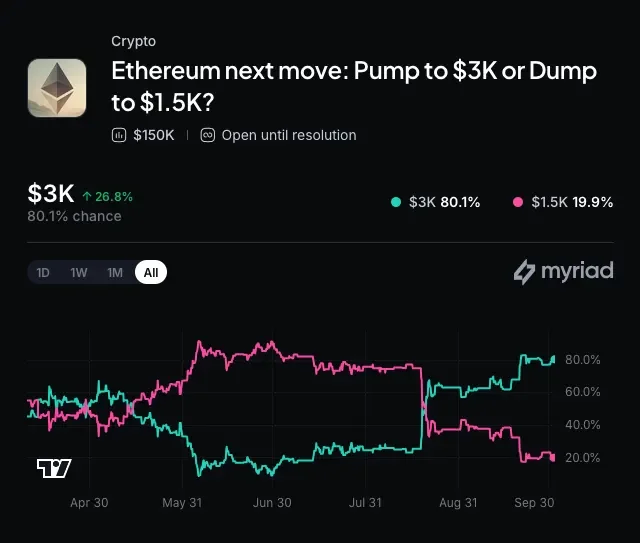
Myriad: Where does Ethereum go next? Click to make your prediction.
The potential implications of zkAPI go beyond mere transactions. Once a user deposits credits, like ETH or USDC, into a vault contract on Ethereum, their balance turns into a private note accessible only to them. “You deposit credits into a vault contract on Ethereum, one ordinary transaction. From then on, your balance exists as a private note: digital cash that only you can spend and that nobody can trace back to the deposit,” the Foundation explained. This system raises an interesting question: how will it reshape interactions between AI services and users who are increasingly wary of data privacy?
In this context, the growing scrutiny over AI privacy is anything but theoretical. Just last May, a federal court compelled OpenAI to retain its output logs, including deleted chats, due to a copyright dispute involving major publishers. With such precedents, zkAPI’s approach could provide users with a much-needed safeguard against similar data exposure.
Every time an inquiry is made to an AI, zkAPI’s software generates a zero-knowledge proof—essentially a mathematical receipt that affirms a user's claim while revealing nothing about the underlying data. This is a significant leap forward in preserving user confidentiality during AI interactions. Each temporary API key generated allows for capped spending and is retained solely in your device's memory.
Moreover, alongside the zkAPI initiative, users can also take advantage of OA Chat, a web-based private chatbot that requires no installation. Its code is made openly available on [GitHub](https://github.com/ethereum/zkapi), emphasizing the transparent development ethos endemic to the Ethereum community.
If you're navigating the complex waters of AI utilities and privacy, zkAPI presents an avenue worth exploring for those who prioritize their data protection against an increasingly watchful digital landscape.
Looking Ahead: A New Era for AI Transactions
The shift towards anonymous interactions in AI transactions is a noteworthy development that merits closer examination. This approach, which leverages ephemeral keys and zero-knowledge proofs, allows users to engage with AI services without exposing their identities. When your requests are made, they’re sent along with a unique key—not your name or financial information—which enhances privacy. Users get billed only for their actual usage, providing a level of financial transparency that could reshape how services are monetized.
Consider the implications here: this model, built upon principles proposed by Davide Crapis and Vitalik Buterin, envisions Ethereum as the backbone for AI systems. The availability of short-lived keys via [OpenRouter](https://zkapi.openanonymity.ai/) means that developers can integrate countless AI models through a simplified interface. The future might see autonomous AI agents communicating and transacting independently, as Crapis envisions, with Ethereum handling millions of these interactions seamlessly.
However, optimism should be tempered with caution. While the protocol is poised to streamline transactions across various metered services—ranging from image generation to data queries—it’s currently labeled as experimental and lacks formal auditing. That's a risk you can't ignore.
Here's the thing: the idea of machines interacting on a decentralized platform is groundbreaking, but operational stability and security must come first. If you're in the tech space, keep your eye on the developments from this initiative. This could very well be the precursor to an AI ecosystem that values privacy and automated interaction.
As we move into this uncharted territory, organizations need to ensure they're equipped to navigate the complexities of these new technologies. The next few years will likely define the frameworks for how AI services evolve and interact with the broader financial ecosystem. Are we ready to embrace this new status quo, or will lingering concerns about safety and transparency stifle its growth? Only time will tell.

Discussion
Sign in to join the discussion.