Enterprises must rethink legacy systems for real-time AI by adopting event-driven architectures, scalability, and modular governance strategies.
The Shift to Real-Time AI in Enterprises
Modern enterprises increasingly depend on real-time AI capabilities to enhance their software platforms. Moving away from traditional batch processing to a model that allows for immediate event evaluation and intelligent response is now essential. While the complexity of AI models is often highlighted, the underlying platform's adaptability and speed of response often prove more critical to success.
Challenges with Legacy Systems
Legacy applications have often been designed around rigid time constraints and tightly integrated components, making them ill-suited for the agile requirements of real-time AI. Migrating these systems to the cloud, while beneficial for infrastructure flexibility, doesn’t inherently yield the desired responsiveness. Rather than a mere lift-and-shift approach, organizations should view modernization as an architectural transformation that enhances responsiveness and integrates AI effectively.
Emphasizing Event-Driven Architectures
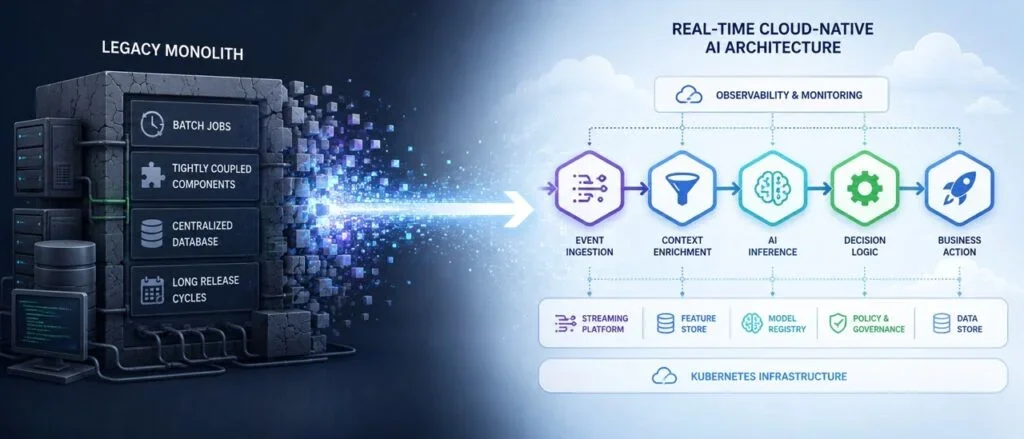
Batch processing serves a purpose for certain workloads, but for AI-driven experiences, an event-driven architecture is vital. In this setup, systems share updates (events) that trigger responses, allowing for dynamic engagement based on changes in customer behavior or operational thresholds. A typical real-time flow could be structured as:
Event → Context Enrichment → AI Inference → Decision Logic → Business Action
This strategy minimizes unnecessary checks, promoting component autonomy while enabling scaling. However, merely implementing a message broker isn't sufficient; organizations must establish clear ownership of events, manage schema governance, and define strategies for error handling and replay scenarios.
Separating AI Inference from Application Logic
Tight integration of AI models within applications can hinder flexibility as these models evolve. Teams working on machine learning must frequently retrain models and switch between different versions or configurations. By isolating inference as a distinct service, applications can interact through a stable API without being tied to any specific model implementation. This not only enhances scalability and allows for more controlled deployments but also simplifies latency measurement.
Focusing on Context Over Just Speed
Having a rapid prediction capability isn't beneficial if the underlying data is outdated. Real-time AI systems must incorporate current and contextual data for accurate decision-making. This involves pulling together historical data, recent transactions, and even user session activities. The aim isn't to ensure all enterprise data is processed in real time; instead, it's about identifying data that critically influences immediate decisions and organizing the architecture around it.
Strategically Decomposing Legacy Systems
Microservices are beneficial for establishing clear ownership and scaling, but they can lead to increased latency and complexity if poorly managed. Decomposing a monolithic application into numerous microservices without clear purpose can introduce new challenges rather than solutions. For successful real-time AI architecture, it’s advisable to segment based on meaningful capabilities like event ingestion, context enrichment, and decision-making processes.
Leveraging Kubernetes for Operational Excellence
Kubernetes can effectively manage workloads with its features like automatic scaling and health checks, which is particularly useful for fluctuating AI and data-processing demands. However, teams should remember that Kubernetes alone doesn’t define an architecture; poorly structured applications will remain inefficient regardless of containerization. A thoughtful architecture that incorporates asynchronous communications, resilience, and stringent observability principles is essential.
Designing for Failure is Essential
When designing distributed systems, assuming components will fail is a pragmatic approach. Services may go offline, network requests may fail, or even downstream dependencies might not be accessible. Solutions must include timeouts, retry strategies, circuit breakers, and mechanisms for managing failures gracefully. Critical applications may also require multi-zone or multi-region support to guarantee reliability across the system.
Incorporating Observability into the Architecture
A robust observability framework is vital, particularly for complex AI workflows that traverse multiple services and components. Implementing metrics, logs, and distributed tracing from the initial stages is imperative to diagnose performance issues or incorrect outcomes effectively. It’s important to monitor not just the operational aspects but also model-specific metrics, ensuring a comprehensive view of both application performance and AI behavior.
Instilling Governance into Runtime Architecture
As AI takes center stage in operational environments, governance becomes a necessary foundation rather than an afterthought. Runtime architectures should include mechanisms for traceability, allowing teams to track which model versions influenced outcomes and the data that informed decisions. This transparency supports both accountability and adaptability in evolving AI ecosystems.
Adopting an Incremental Modernization Approach
For many organizations, a complete system overhaul is impractical. Instead, they can incrementally introduce cloud-native features while maintaining legacy systems. By utilizing APIs for existing capabilities and surrounding critical functions with new services, businesses can advance to a modern infrastructure without experiencing the disruption of a full-scale migration. This gradual transformation proves essential for implementing real-time AI capabilities effectively.
Conclusion: Embracing a Holistic Architectural Mindset
The most effective cloud-native AI frameworks will be less about choosing the right technology stack or model, and more about fostering an architecture that embraces change. Characteristics such as loosely coupled services, event-driven processes, and integrated observability will define the agility of future systems. Shifting the question from "How do we move this application to the cloud?" to "How should this system function if real-time intelligent decision-making is integral?" sets the stage for meaningful transformation in cloud-native environments.
Discussion
Sign in to join the discussion.