Discover how local small language models optimize privacy, control, and speed, while enhancing your AI project architectures.
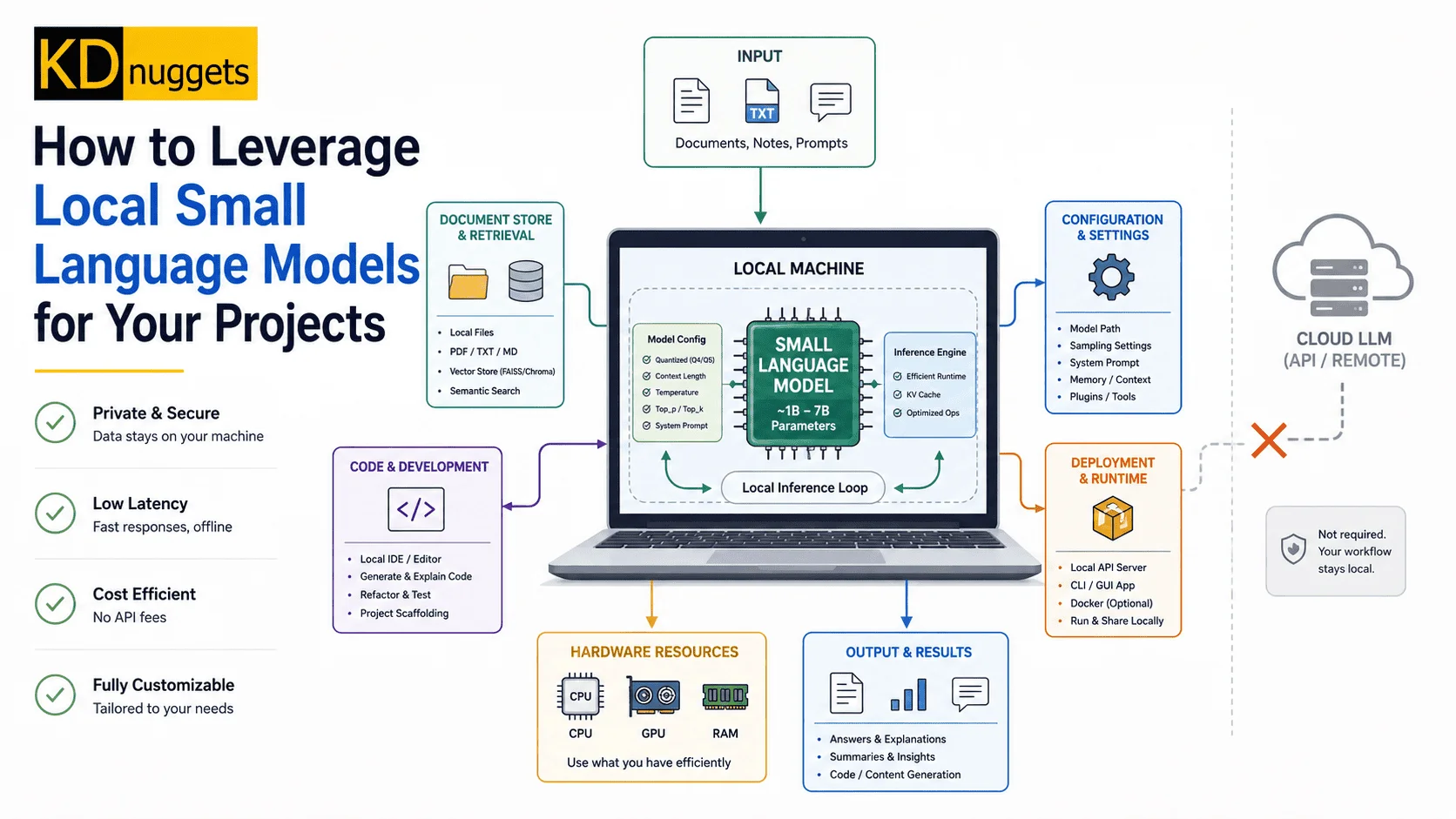
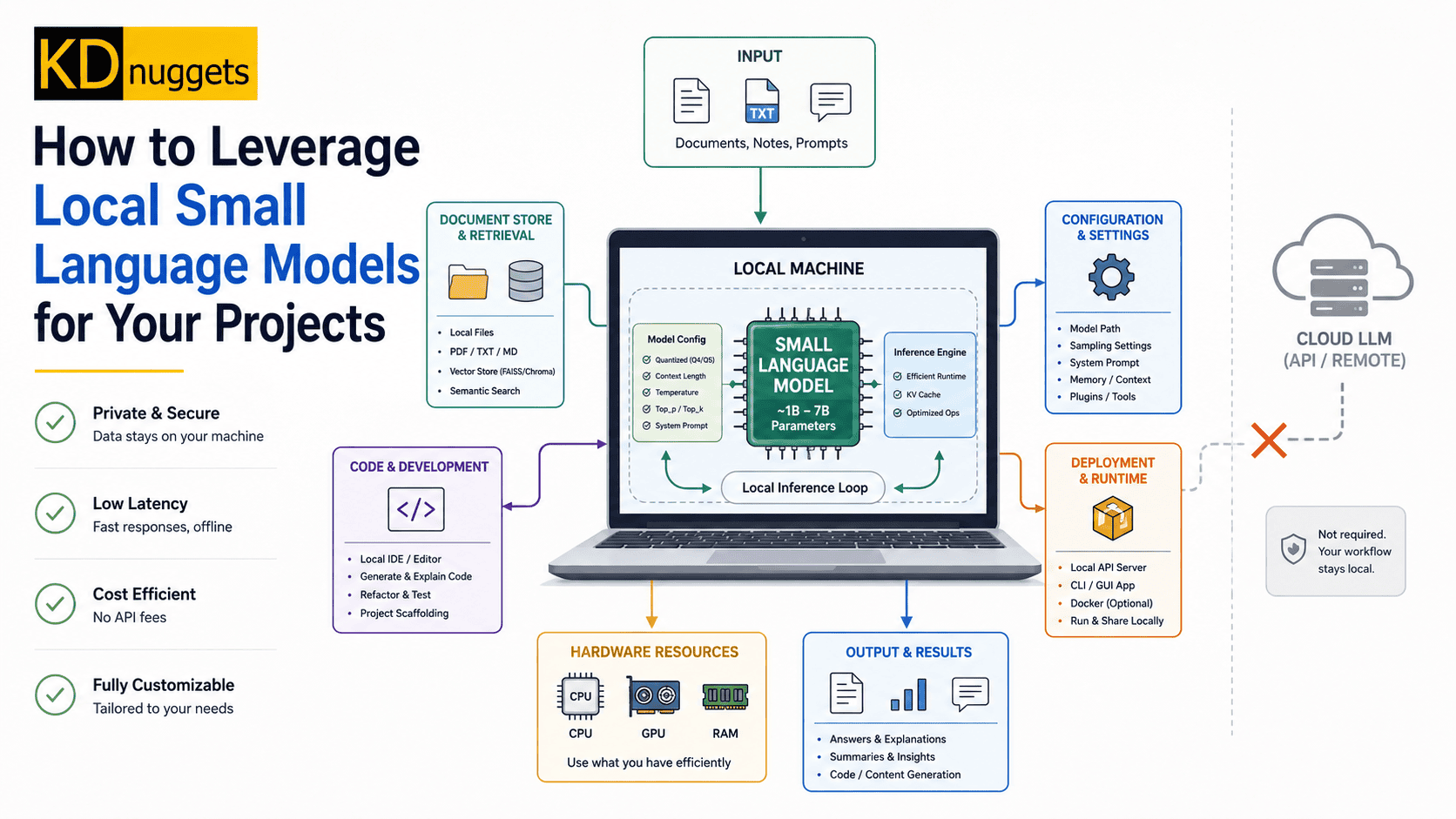
For years, the prevailing notion was that larger models lead to better performance, compelling developers to rely on cloud APIs despite the inherent challenges of latency, cost, and data security. However, this perspective is evolving as the capabilities of small language models (SLMs) demonstrate a practical alternative.
# The Value of Local SLMs
Local small language models, typically encompassing 1 to 13 billion parameters, are designed to be efficient enough to operate on personal laptops or consumer-grade GPUs. The advantages they present are compelling:
- Privacy and Data Control: Running an SLM on your local hardware ensures that your inputs and outputs stay within your environment, eliminating third-party exposure — a critical aspect for projects dealing with sensitive or proprietary information.
- Cost Predictability: With local models, expenses are fixed to the hardware you own, removing variable API costs and allowing for more flexibility in prototyping and scaling.
- Reduced Latency: Operating locally negates potential network delays, which can lead to a significantly enhanced user experience in interactive applications.
Nevertheless, local setups come with their challenges. Local models, while beneficial, may offer smaller context windows and varying degrees of complexity on intricate tasks. Moreover, they necessitate hardware that meets their demands—typically requiring at least 8 GB of VRAM or RAM to operate effectively.
# Selecting the Appropriate Model
Choosing the right SLM hinges on multiple factors, including your hardware capabilities and the specific requirements of your tasks.
- Parameter Count: Generally, models with 1 to 3 billion parameters function well on most contemporary machines with 8 GB RAM, while 7 billion parameter models offer a sweet spot for quality and performance. Consider 13 billion parameter models if you have superior hardware available.
- Task Specialization: Match models to their tailored tasks — for example, Code Llama excels in coding tasks, while others may be better suited for summarization or chat functions.
- Quantization Format: This impacts both size and speed, with GGUF format being common. Models can often be quantized for efficiency, ensuring a reasonable sacrifice in quality for improved speed.
- Popular Model Families: Notable examples include Llama 3, Mistral, Gemma 2, Phi-3, and Qwen 2.5—evaluate them against your requirements to find the best fit.
# Deploying with Ollama
After selecting a model, you need a reliable way to execute it. Ollama stands out as an approachable solution for running SLMs locally. It simplifies model management, GPU acceleration, and establishes a local API endpoint through a straightforward command-line setup, applicable across multiple operating systems.
With a single command, you can set up a model, which is served via a REST API, making it accessible to your application akin to any HTTP-based API. The integration with libraries like LangChain and LlamaIndex enables straightforward incorporation of local models into your existing frameworks. Beyond pre-curated models from Ollama, you have the option to access models from platforms like Hugging Face, expanding your selection to community-tuned variants.
# Fine-Tuning Configuration for Optimal Performance
Effective deployment involves more than just running a model—it requires meticulous configuration tailored to your specific system and use case.
Ollama employs Modelfiles to outline a model’s settings, akin to Dockerfiles. This allows modifications to characteristics such as system prompts, context window lengths, temperature settings, and output formatting guidelines. Pay particular attention to:
- Context Window Size: Larger contexts amplify memory usage, so if your application handles shorter prompts, opt for smaller windows to enhance performance.
- Temperature: This parameter influences output variability. For tasks requiring precision, lower settings yield more consistent results, while higher values are suited to creative endeavors.
- System Prompts: Crafting a precise system prompt can significantly elevate output quality by defining expectations and constraints for the model.
# Project Architectures Optimized for Local SLMs
Once your model is primed, consider how it can fit into your project architecture. Local SLMs excel in specific frameworks that capitalize on low latency and proprietary data access.
- Document Question-Answering: Leverage a local SLM alongside a retrieval system to create a pipeline for addressing queries about internal files or documentation securely.
- Coding Assistants: Models designed for code generation can be integrated into development environments, allowing local project context access without external API interactions.
- Agentic Workflows: These involve more complex interactions where a model functions as an intelligent agent that decides which tools to use and in what order based on project goals.
- Automated Data Processing: Running structured extraction and classification tasks locally ensures sensitive data stays secure, effectively aligning model capabilities with necessary workflows.
# Validating Model Performance Before Full Adoption
Prior to full integration, it’s wise to assess that your chosen model meets the expectations of your specific application. Establish a small evaluation set of 20 to 50 samples to gauge model performance, focusing on relevant inputs and their anticipated outputs.
Consider failure modes alongside average performance; models with small failure percentages might be less suitable than those that perform consistently. Ensure you test context lengths that mirror your expected inputs, especially for tasks dealing with longer documents.
# Educational Resources for Further Exploration
To deepen your understanding of small language models and their practical applications, the following resources are invaluable:
- Introduction to Small Language Models: The Complete Guide for 2026
- Ollama Tutorial: Running LLMs Locally Made Super Simple
- Tweaking Local Language Model Settings with Ollama
- Use Almost Any Language Model Locally with Ollama and Hugging Face Hub
- Exploring the Role of Smaller LMs in Augmenting RAG Systems
- Small Language Models are the Future of Agentic AI
# Concluding Thoughts
The evolution of local small language models signifies their transition from experimental tools to practical solutions for developing AI-driven applications. With accessible resources such as Ollama and a variety of deployment architectures, developers are now positioned to create effective applications without relying on external cloud services.
The best strategy is to take incremental steps: begin with a precisely defined task, select an appropriate model, configure it thoughtfully, and validate performance before scaling further. The focus should be on finding a model that’s optimized for your specific needs, rather than defaulting to the largest option available. As the ecosystem of small language models continues to advance, getting familiar with these tools will empower you to leverage their full potential in future projects.
Vinod Chugani is dedicated to bridging the gap between emergent AI technologies and their practical applications, emphasizing actionable strategies for professionals. His expertise, spanning AI, data science, and workflows, supports individuals in skill development and career transitions.
Discussion
Sign in to join the discussion.