Streamlining Kubernetes Deployment: Ensuring Application Health Beyond Success
Aug 13, 2026 · 382 views
Close the gap between deployment completion and application readiness with automated health checks to boost validation speed and confidence in Kubernetes.
From Green Light to Health Check: Bridging the Kubernetes Deployment Gap
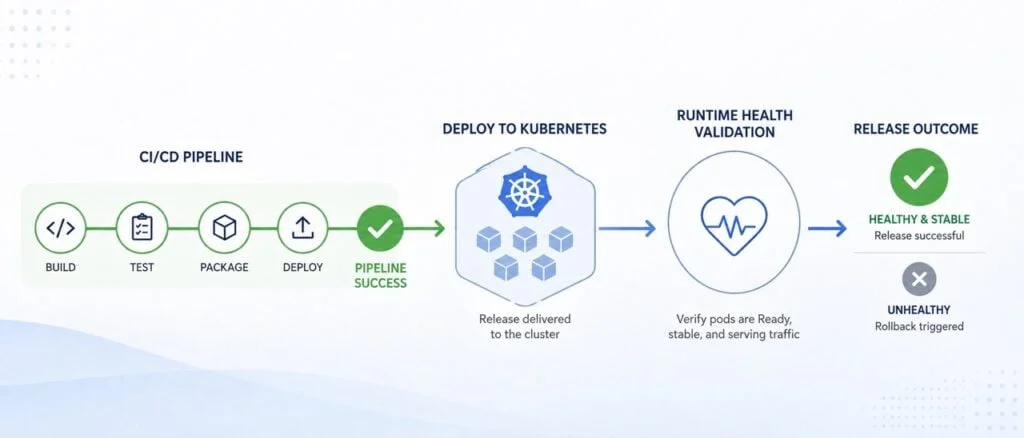
In the world of release engineering, a successful CI/CD pipeline gives a momentary sigh of relief when it turns green. But in the context of Kubernetes, that moment can be misleading. A green light means the deployment step completed, yet it doesn't guarantee that the application is actually functioning properly. This distinction is significant; understanding it can make or break a release.
The team I’m part of manages Kubernetes workloads in a massive payments ecosystem. Initially, we faced a troubling disconnect between deployment success and application readiness—a gap that, in our case, caused anxiety, increased manual effort, and led to inconsistent validation results. To address this, we turned to automation, transforming manual checks into streamlined CI/CD processes. This shift slashed our validation time from 45 minutes down to just 2 minutes—a real productivity boost. But beyond speed, the real win was enhancing consistency and building confidence in our deployments.
The Critical Health Check Distinction
It’s essential to understand the difference between deployment completion and application health. The former indicates that code has been delivered to the environment, while the latter confirms that the application is ready to serve users. For example, after a deployment, there are several crucial questions that must be answered: Are the workloads scaled back up? Did all the pods start without issues? Are they in a Ready state? Can the application handle incoming traffic without crashing?
Just because a deployment has completed, that doesn’t mean all systems are go. A pod might appear as 'Running' but could fail its readiness probe. Another pod could crash shortly after starting, or it may be stuck in a Pending state due to resource limitations. These scenarios introduce risk: the pipeline may consider the deployment successful, while users experience degraded service.
We needed to close this reliability gap by shifting our focus from assuming health post-deployment to actively verifying it.
The Traditional Manual Workflow and Its Flaws
Practicing release validation manually presented a series of laborious steps. Engineers logged into Kubernetes clusters, navigated through namespaces, scaled deployments down, checked pod statuses, and performed numerous checks within strict time limits. Although each task was manageable, the accumulation of these efforts during large-scale releases could easily lead to mistakes due to human error or oversight—each namespace could be skipped, checks could be rushed, and confidence in release readiness fluctuated.
As we expanded our services, this manual method became untenable, leading to errors that jeopardized release quality. We realized the reliability of our releases shouldn't solely rely on personnel carrying out these repetitive checks under pressure.
This led us to simple yet profound question: Could we take the trusted manual checks and automate them within our pipeline?
Smart Automation: Building a Streamlined Process
We chose not to invest in an elaborate platform or replace our existing deployment system. Rather than complicate our infrastructure, we enhanced the CI/CD pipeline that already executed Helm actions and monitored pod statuses. Our aim was uncomplicated: eliminate manual repetition while ensuring consistent validation.
Now, the pipeline automatically governs the release process. It scales down the workloads, checks for pod availability, deploys the new code, scales the workloads back up, and finally verifies their health. Should there be any discrepancies, the system flags the failing pod and the reasoning behind it—a clear signal that aids rapid troubleshooting during deployments.
This newly implemented workflow mimics a control loop: observe status, assess health, proceed if healthy, pause if changing, and roll back if deficits are found.
Understanding Pod Readiness: More Than Just Running
A critical check in our automated validation is pod readiness. In Kubernetes, the states of Running and Ready are distinct. A pod might be Running, but unless it’s marked as Ready, it can’t serve traffic reliably—a crucial distinction during a deployment.
Consider a situation with multiple replicas: all pods may appear as Running, yet if only some are marked Ready, it suggests the application isn't fully operational. This insight is why our automation checks not just the Running state, but also the readiness of each pod.
Each failure or transition sends engineers in various directions toward resolution, making it imperative for the pipeline to categorize issues accurately.
A Failure Is Not the End: The Importance of Stability Windows
A pivotal aspect of our design includes a 60-second stability window. Initially, permitting a release to pass as soon as pods turn Ready seemed an efficient tactic, but we quickly learned it could foster false confidence. A pod can easily report readiness and then fail shortly after.
To combat this, our automation monitors pod stability for a full minute after all are marked Ready. If any pod regresses during this period, the timer resets. This ensures we pass a release only when we can genuinely trust that the application will remain stable.
Transforming Our Validation Process
The speed of our validation process is an obvious result of this automated system—cutting down from 45 minutes to 2 minutes for large releases is impressive. Yet, the real transformation lies in the consistency this method provides. Each release now adheres to the same validation path, eliminating human error that could arise from rushed or incomplete manual checks.
With earlier detection of problems—rather than relying on engineers to hunt down issues—the pipeline now identifies unhealthy pods and clarifies failure reasons. This not only expedites the troubleshooting process but also enhances overall team confidence in the procedures.
For site reliability engineers, the objective has shifted from mere speed in deployment to an assurance of application health in real-time.
What We've Learned Moving Forward
The biggest takeaway from our journey is clear: a release isn’t complete when the pipeline shows green; it’s only done when the application stands stable and healthy.
Our solution didn't hinge on a complex architecture but on intelligent, lightweight automation embedded within our CI/CD workflow. By employing the checks that engineers regularly executed, the deployment process evolved into a more efficient, reliable system. This transformation serves as a roadmap for other teams facing similar challenges in Kubernetes deployments. Start by identifying existing checks, automate repetitive tasks, and establish health verification before announcing a successful release.
That’s how we redefine what a "green pipeline" truly signifies: not just the completion of a release but the trustworthiness of the application moving forward.
Discussion
Sign in to join the discussion.