HSBC Brings Hong Kong Dollar Stablecoin Payments to PayMe
Oct 24, 2026 · 488 views
HSBC’s RedCoin lets PayMe users send Hong Kong dollar stablecoins and pay at over 100,000 merchants, bringing digital currency closer to everyday payments.
A bank is bringing stablecoins to ordinary payments
HSBC’s RedCoin launch matters because it puts a bank issued digital currency inside a payment app people already use. The Hong Kong dollar stablecoin went live Friday on PayMe, where more than 3.3 million users can activate wallets in the coming days. They’ll be able to send RedCoin to friends and pay at more than 100,000 PayMe merchants, according to the bank’s
announcement. HSBC says it plans to add the token to its Hong Kong Mobile Banking app later this year.
“We are excited by the market's interest in HSBC RedCoin. This is only the beginning,” said John O'Neill, HSBC’s managing director of digital assets and currencies. He said the bank would add products and expand into wholesale corporate and institutional uses.
For consumers, the pitch is straightforward: RedCoin, ticker RCHKD, is designed to hold the value of one Hong Kong dollar. Someone could use blockchain based money from the same bank that holds their salary to pay for lunch, without signing up for a crypto exchange. That’s a more practical test for stablecoins than another trading venue. Whether customers will see enough benefit to change how they pay remains unclear.
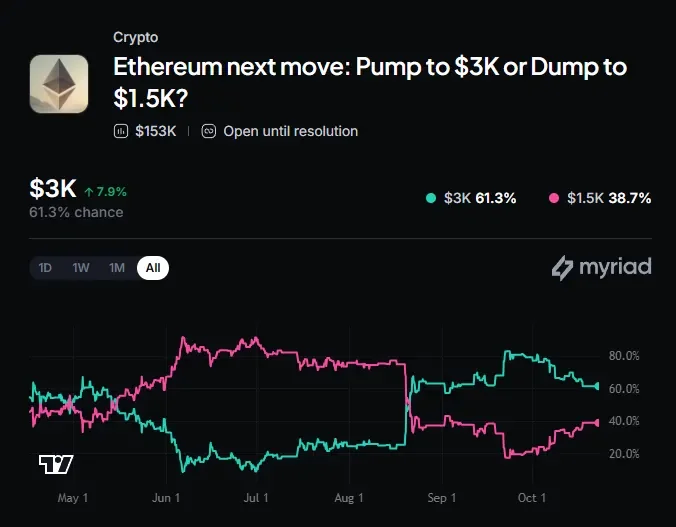
Myriad: Where does ETH go next? Click to make your prediction.
A small start, with some important limits
Stablecoins have largely served crypto businesses so far. Tether’s USDT and Circle’s USDC lead a market valued at more than $300 billion, with most of that money circulating on trading platforms rather than being used at local shops. RedCoin’s retail access is a notable departure, though its initial scale is modest: HSBC’s reserve tracker showed about $10.2 million in circulation shortly after launch, backed entirely by $10.4 million in cash. That’s pocket change beside USDT.
The infrastructure also comes with boundaries. RedCoin runs on HSBC’s private ledger, not a public blockchain such as Ethereum, and users can’t transfer balances between PayMe and HSBC’s banking app. Nor is the token a bank deposit: Hong Kong’s statutory Deposit Protection Scheme, which insures savings accounts, doesn’t cover it.
HSBC received its issuer license from the Hong Kong Monetary Authority, the city’s de facto central bank, in April. The licensing regime took effect in August 2025. By September that year, at least 36 companies were competing for approval. The early question is less whether HSBC can put a stablecoin in front of millions of users than whether those users will find a reason to use it.
Stablecoins are moving closer to everyday banking
HSBC’s next step is to put RedCoin in front of customers through its HK Mobile Banking app later this year. The bank also plans to offer a tokenized share class of its established Hong Kong dollar money market fund, which invests cash in short-term debt. In this setup, a digital token records who owns the investment instead of a conventional registry. That could make tokenization feel less like a crypto product and more like another way to access familiar bank services.
The competition is gathering. In September, 21 lenders, including Goldman Sachs and Bank of America, announced plans for a shared dollar stablecoin, with a launch targeted for the first half of 2027. Banks clearly see a role for their own digital money in everyday payments. Whether customers will care who issued a stablecoin—or simply choose whichever one is easiest to use—remains an open question.
Trust will be another test. HSBC expects the first independent attestation of RedCoin’s reserves after the fourth quarter of 2026. That report is meant to confirm that the cash backing the token is actually there. Until it arrives, the bank’s plans show how quickly stablecoins are entering mainstream banking, while leaving a basic question unresolved: how much confidence should users place in the reserves before an outside auditor has checked them?

Discussion
Sign in to join the discussion.