For fleets of hundreds of Kubernetes clusters, staged release promotion adds verification, visibility and a stop point between a Git merge and broad deployment.
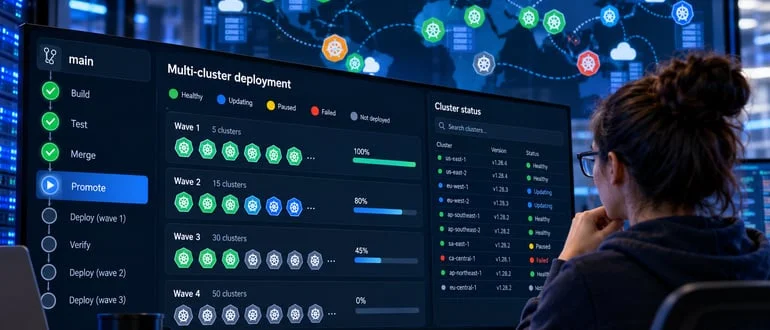
At fleet scale, the hard part of GitOps isn’t getting a change to clusters. It’s deciding when that change has earned the right to reach the next group. A single merge can update hundreds of production environments, leaving teams to depend on pre-release testing to catch problems before they spread. Release promotion adds a missing control point: verify a change in stages, then advance it only when it meets defined conditions.
That distinction matters well before a fleet reaches thousands of clusters. A pipeline that feels safe at five or twenty clusters can make engineers hesitate at around fifty. The hesitation is a signal: the deployment process may be automated, but the team doesn’t have enough visibility or control to trust what happens after merge.
When one merge becomes a fleet event
A platform engineer described a setup built for more than 200 production clusters. The environments were dedicated and single tenant, distributed across multiple clouds. The GitOps workflow followed a familiar model: merge a change to the main branch, and the desired configuration synced across the fleet.
That arrangement can be straightforward when the fleet is small. With hundreds of clusters, the merge became a fleet-wide event without an intermediate gate. The team relied on one replica environment to identify failures before deployment. Validating a release there took weeks; once the change was released, propagation across the production fleet took about an hour.
The imbalance is revealing. The rollout itself was quick, but the process offered no controlled path between the replica environment and the full fleet. If a defect escaped validation, the change could reach every cluster before teams had a chance to learn from its behavior in production.
Here’s the thing: making distribution faster doesn’t solve that problem. It can reduce the time spent copying configuration, but speed can also widen the blast radius when every cluster updates together.
Synchronization and promotion have different jobs
Continuous integration can build and test a release. A GitOps controller can reconcile a cluster’s configuration with the desired state stored in Git. Those are useful capabilities, but they don’t necessarily decide whether a release should advance from one cluster group to another.
Synchronization answers a question about state: does this cluster match what Git declares? Promotion answers a question about release progress: which version is running where, what evidence has it passed, and which clusters may receive it next?
That difference is easy to miss when the fleet is small. At scale, teams need to see the version deployed to each group, understand what checks it has passed, and know why a rollout is continuing or paused. The platform engineer’s priority wasn’t simply a friendlier interface. It was making the fleet legible enough to support release decisions.
A promotion layer should connect rollout stages to verification results. If an early group passes its checks, the next group can receive the release. If a check fails, the release should stop there while the remaining clusters stay on their existing version. That gives engineers a chance to investigate a real deployment signal before increasing exposure.
Existing tools provide useful pieces
Several Kubernetes fleet tools already help distribute configuration and control rollout order. ApplicationSets, Rancher Fleet, Open Cluster Management (OCM) and Karmada address the challenge of applying configuration across many clusters without maintaining a separate hand-written manifest for each one.
Some also support staged rollouts and reactions to cluster health. Argo CD ApplicationSet Progressive Syncs can sequence updates. Rancher Fleet offers rollout partitions, while OCM supports progressive ManifestWorkReplicaSet strategies. These capabilities help teams organize deployment into waves and pause when clusters become unhealthy.
That foundation matters, but sequencing alone doesn’t necessarily amount to a full promotion workflow. Teams still need to know whether the system tracks a distinct release, keeps its verification history, and uses that evidence to decide which group may update next. The practical question for platform teams is how much of that path their existing setup covers—and where they need to add release tracking or decision logic.
There’s no value in adding a separate layer just to duplicate rollout controls that already work. But if a team can pause a wave without retaining a clear record of what was tested and why the release advanced, it may still lack the information needed to manage releases confidently across a large fleet.
Promotion makes release state visible
In the 200-cluster example, the needed workflow was simple to describe: deploy to a small group, check the results, then decide whether to continue. The difficulty was that the existing path went from merge to the full fleet, with the release process depending on weeks of prior validation to prevent trouble.
Promotion gives the team a way to make advancement conditional. Git remains the source of desired state, while cluster groups can move to a new version in stages as the release satisfies its requirements. Engineers can trace where a version is running, what verification it has passed, and why a group has or hasn’t advanced.
That visibility becomes more important as fleets approach a thousand clusters. At that size, a stalled rollout should communicate more than the fact that deployment stopped. Teams need to know which group halted, what check failed, and which clusters remain on the previous release. With that record, they can investigate the failure without pushing the same change to the rest of the fleet.
My read is that release promotion will become a standard part of large-scale delivery because fleet growth changes what teams need from automation. Sync speed and reliability will keep mattering, but they won’t answer every operational question. Teams also need a controlled release path that connects each version to its verification results and limits where it can go next.
Start with a small deployment wave
Before a broad rollout, pick a small group of clusters to receive the release first. Define the checks that must pass before the next group updates, then confirm that a failed check actually prevents the release from spreading. That exercise tests the control path as well as the application change.
A cautious merge is often a clue that engineers don’t trust the consequences of deployment. Staged promotion gives them a way to replace that hesitation with evidence: test the release on a limited slice, inspect the result, and advance only when the agreed conditions are met. For large Kubernetes fleets, that makes GitOps easier to operate because the decision to proceed becomes visible and repeatable.
KubeCon + CloudNativeCon North America is scheduled for November 9–12 in Salt Lake City. Event details and registration.
Discussion
Sign in to join the discussion.