Enhancing Security in Kubernetes Deployments Through Container Image Signing
Oct 08, 2026 · 483 views
Container image signing adds a crucial layer of trust in CI/CD workflows, ensuring deployed artifacts are authentic and secure in Kubernetes environments.
Understanding Container Image Signing and Its Importance
Container image signing is emerging as a pivotal component in securing modern application deployment, especially in environments leveraging Kubernetes. While it's easy to assume that a successful Continuous Integration (CI) pipeline guarantees a secure release, there's an unsettling reality: just because an image clears every automated check doesn’t mean it’s the exact artifact you intended to deploy.
Consider this: a build might succeed, unit tests could pass, and even vulnerability scans might show no critical issues. However, none of this ensures that what’s running in production is the same version of the image that was approved. This disconnect highlights the inherent risks tied to containerized deployments, where the integrity of the software supply chain becomes a pressing concern.
The Role of Image Signing
This is where image signing steps in. It introduces cryptographic proofs that associate a specific artifact with its identity, enabling you to verify who signed it and whether that identity has the authority to do so. Let's break this down. The signing process effectively adds a layer of trust, linking the software artifact to its approved origin within the deployment ecosystem.
For teams engaged in DevOps, the paradigm shifts. It’s not just about whether the image was built correctly; it’s also about verifying its provenance and confirming that it's what should be running in a production environment. This becomes critical as organizations embrace automated deployments, ephemeral CI runners, and stricter control over their software supply chains.
The Image Signing Workflow
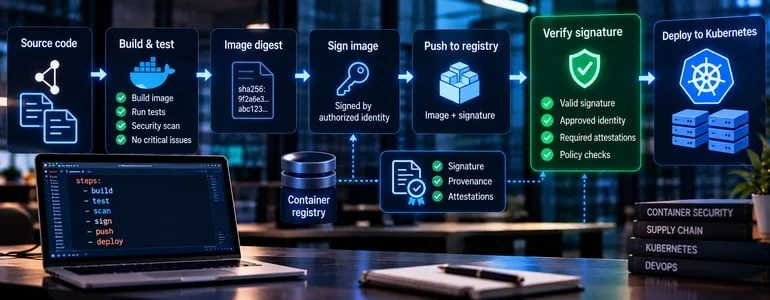
Image signing isn't a stand-alone step; it serves as a vital link in a chain that includes source code, build environments, image registries, and deployment policies, all tightly woven into the Kubernetes architecture. A streamlined workflow typically follows this path: source code enters the CI/CD pipeline, the image is constructed and tested, security assessments are executed, an artifact digest is obtained, and finally, the image is signed before being deployed.
The core takeaway? Signing complements existing CI/CD security protocols rather than substitutes for them. It acts as an additional trust signal that aligns with broader security practices, emphasizing the need for organizations to include image signatures in their software release strategies.
Why Signing Matters
Speaking of security, while container registries serve as central repositories for images, access to these registries alone does not guarantee the authenticity of the artifacts. An authenticated user can push an image, but if that access is compromised, you risk deploying unauthorized content. Signing enhances the reliability of your images by enforcing deployment policies such as requiring only signed images from approved identities or mandating that unsigned images be completely rejected.
The ultimate objective isn't about placing unfounded trust in one part of your infrastructure. Instead, it’s about establishing a trust landscape rooted in verifiable evidence that can confirm the integrity of software at every critical juncture.
Decoding What’s Signed
Understanding what constitutes a container image is essential for effective signing. Unlike a single file, these images comprise manifests and layers with structures that can change over time. The significance of this lies in maintaining the association of the signature with a specific identity, thereby ensuring that when you deploy an artifact, you know exactly what you're deploying.
While tags can help identify versions of images, they can be misleading. Tags can point to different artifacts or even be altered by those with sufficient access. Instead, reliance on immutable digests ensures that a signature truly corresponds to the desired content. By tying signatures to specific content identities, you can significantly mitigate the risks of deploying an incorrect version.
In summary, as you navigate the complexities of container deployments, integrating image signing into your workflow isn't just a best practice—it's a necessity. It builds a framework of accountability and verification that is essential for the integrity of your software delivery lifecycle.
Conclusion: The Imperative of Trusted Delivery
The discussion around container image signing reveals vital truths about securing software delivery pipelines. At its core, image signing establishes a cryptographic link between an artifact and its creator, which is essential in a landscape riddled with potential vulnerabilities. But signing alone isn’t the endgame; it’s the connection of this evidence to the entire software delivery system that counts.
When we consider a deployment in Kubernetes, it’s not just about whether the image bears a valid signature. The deployment process requires a comprehensive strategy that encompasses provenance, security attestations, and a transparent record of how the software was constructed. Each of these components has its role, answering different questions about security and integrity. For example, knowing an image was signed doesn’t ascertain its vulnerability status, and a signature doesn’t verify the trustworthiness of its dependencies.
Here's the thing: organizations that limit their attention to signing alone may overlook critical aspects of security. If a compromise occurs at any point in the CI/CD pipeline—before the signing occurs—the outcome could be dire, even if the final image shows a valid signature. Thus, monitoring must extend beyond the image itself and include the entire build environment and workflow.
As we move forward, integrating signing with detailed evidence such as SBOMs and consistent provenance is crucial. That method provides a rich framework for decision-making in deployment, laying out a path for development teams to make informed trust decisions.
It’s no longer just about putting a signature on an artifact. It’s about framing an ecosystem where each piece of evidence stands as a testament to the software’s reliability. For DevOps teams, understanding this shift is vital. As the infrastructure becomes more complex, ensuring that each artifact—from build to deployment—is accompanied by reliable proof of its integrity and origin becomes the standard through which secure systems are built.
Discussion
Sign in to join the discussion.