Explore essential concepts of Kubernetes controllers and their interaction with the API, enhancing memory management and performance efficiency.
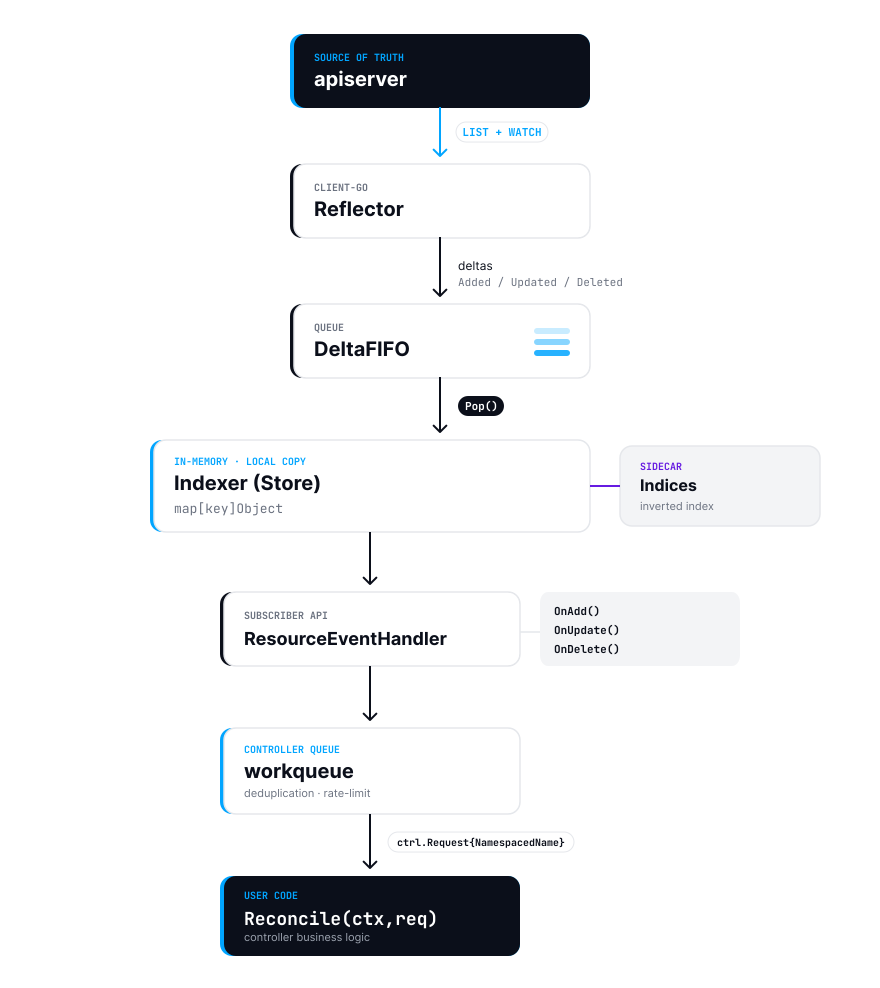
The Underpinnings of Kubernetes Controllers
Kubernetes has established itself as the go-to solution for managing distributed workloads, but many developers still grapple with its intricacies, especially when creating their own controllers. While initiating a controller using tools likekubebuilder and controller-runtime can be accomplished in just a few hours, the real challenge surfaces under heavy load or unexpected behavior. This often exposes a deeper issue: a vague understanding of how controller-runtime operates at its core.
If you write Kubernetes controllers in Go, becoming well-versed in the inner workings of controller-runtime is essential. This article aims to clarify those complexities, helping practitioners avoid costly missteps that could manifest in production environments.
Getting to the Heart of Controller Functionality
The main focus here is to demystify the mechanics behind how controllers interact with the Kubernetes API. Contrary to common belief, operations liker.Get() and r.List() within a Reconcile function do not directly query the API server. Instead, they rely on a local cache populated through a list and watch mechanism. Here's the key takeaway: while reads from this local cache are efficient and won’t burden the control plane—even at high frequency—this design choice can lead to substantial memory usage and possibly stale data issues.
This article delves into various architectural choices foundational to Kubernetes itself, presenting practical implications on memory management, network traffic, read consistency, and behavior during reconciliation.
Why This Matters
Here's where it gets significant: the misconception that reads directly hit the API server can lead to poor performance and wasted resources, especially if you're not clear about how the cache operates under the hood. By understanding that reads are cheap but potentially inconsistent right after a write, you can better architect your controllers. Post-write reads need careful consideration because they could yield outdated information. It’s troubling how an improperly constructedList() function could inadvertently trigger an expensive linear scan across thousands of objects. What this means for developers is that there’s a fragile balance between efficiency and accuracy—something that can be easily overlooked but critical for stable applications.
Understanding Reconciliation Loops
To contextualize our earlier discussions, let’s clarify what a reconciliation loop is. At its essence, a controller in Kubernetes continuously checks and attempts to align the desired state of an object with its actual state. This cyclical process includes various steps: an object mutation triggers an event, which queues an action; then, theReconcile method checks the present state, decides on further actions, and the cycle continues.
The significance lies in where a controller observes changes and reads state from—this cache is central to understanding how data flows through the system. For a live demonstration, consider using kubectl get pods --watch. In watch mode, it subscribes to the same event stream from which controllers gather information. Contrarily, polling is not the mechanism here; it's all about receiving updates and maintaining current local data.
So, for engineers engaging in controller development, this foundational knowledge isn't just useful—it's vital for creating efficient, responsive, and stable Kubernetes applications. The rest of this article will systematically explore how these components are interlinked, underlining the importance of a solid grasp on the caching model.### Understanding Event Handling and Deduplication
When an event like creating a Deployment is initiated (let's say, with `spec.replicas=1`), and subsequently updated by incrementing replicas to `2` and then to `3`, each action is queued in a specific order. The system doesn’t take shortcuts. Initially, you get an `OnAdd` event followed by two `OnUpdate` events corresponding to the transitions from `1→2` and `2→3`. Every event handler gets triggered in sequence, meaning your handler will execute three times in this instance.
Notably, there’s a deliberate asynchronous handling strategy at play. The event store is updated *before* any event handler gets notified. This means that once the informer writes to the indexer, it passes on the notifications to a per-subscriber buffer. Each subscriber’s goroutine manages that buffer later. Consequently, the handler may see an updated state in the indexer that might have already advanced, which can lead to some confusion: if you're processing the update from `1→2`, a cache `Get` may return `3` or potentially `NotFound` if the object was deleted in the meantime. Therefore, treating the store's state at the time of the event isn’t advisable.
### Deduplication in the Workqueue
Interestingly, deduplication behavior exists but operates on a different level; it’s managed within the controller's workqueue. Here’s how it works: for each update event, the controller's handler extracts the `namespace/name` key and enqueues it. If another event with the same key arrives, it merges with the existing entry in silence. The workqueue remains agnostic to what the actual object is.
To illustrate, consider this scenario: you create a Pod, and shortly after, the scheduler begins assigning a node, and the kubelet transitions it through multiple states — `Pending`, `ContainerCreating`, and finally `Running`, then `Ready`. Despite the flurry of updates, the workqueue ultimately condenses them down to just one entry associated with the `default/my-pod` key. By the time the `Reconcile` method pulls this entry, the cache reflects the last state precisely, and only one execution of `Reconcile` is necessary.
This architecture creates two distinct layers with clear responsibilities:
- **The Delta Queue** serves as an ordered list of changes, making sure consumers receive notifications for all events in sequence without merging them.
- **The Workqueue** holds deduplicated keys. It compresses multiple updates into a manageable result for the reconciliation process.
If you grasp this dual-layer concept, it becomes evident why an influx of events related to a single object doesn’t significantly burden the controller's throughput; the workqueue effectively handles the surge.
Discussion
Sign in to join the discussion.